The Supreme Court of India has sharply rebuked West Bengal authorities over a shocking attack on judicial officers in Malda, where officials conducting Special Intensive Revision (SIR) duties were gheraoed and assaulted. Calling it a grave breakdown of law and order, the Court directed the deployment of central forces to ensure protection of judicial personnel. The intervention underscores the seriousness with which the judiciary views any attempt to obstruct court-mandated electoral processes.
Supreme Court’s Stern Intervention
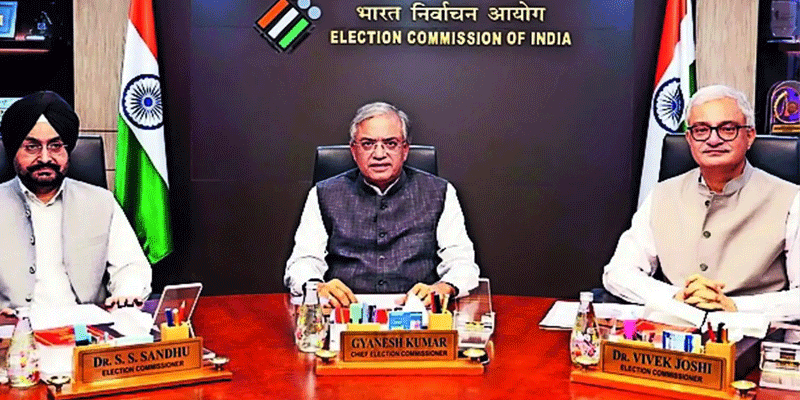
Led by Chief Justice Surya Kant, the bench termed the incident a “calculated and deliberate” act aimed at derailing the electoral revision exercise. It held top state officials—including the Chief Secretary and Director General of Police—accountable for what it described as a “criminal failure” to ensure the safety of judicial officers. In a significant move, the Court directed the Election Commission of India to requisition central forces such as the CRPF and BSF for safeguarding SIR proceedings, while also insulating judicial decisions from executive interference by routing appeals through a dedicated tribunal.
The Malda Gherao: Anatomy of an Attack
The incident unfolded in Kaliachak, Malda district, where seven judicial officers—three of them women—were conducting hearings related to voter list revisions. Around mid-afternoon, a large group of protesters, reportedly aggrieved over potential deletion of names from electoral rolls, surrounded the venue and blocked all exits. What followed was a prolonged nine-hour gherao, effectively holding the officers hostage without access to basic necessities.
Despite repeated alerts to authorities, no decisive action was taken for hours. It was only after midnight that police intervened to evacuate the officers. However, the situation escalated further during the evacuation, as the crowd attacked vehicles with stones and sticks, damaging property and endangering lives. The officers were eventually rescued under heavy security, but the episode exposed a near-total collapse of administrative response.
Political Undercurrents and State Response
Chief Minister Mamata Banerjee has earlier criticised the SIR process, alleging selective targeting of her state and questioning the Election Commission’s timelines. While framing the issue as a political dispute, the Supreme Court’s strong stance shifts the narrative toward institutional integrity and rule of law. The optics of judicial officers being attacked have significantly weakened the state’s position and raised concerns about governance in a politically charged environment.
Broader Implications for Governance
The Court’s directive to deploy central forces marks a critical assertion of federal authority in ensuring the safety of judicial processes. It signals that electoral integrity and judicial independence cannot be compromised, even in highly polarised states. The incident also highlights the risks of mass mobilisation turning into direct challenges to institutional authority, blurring the line between protest and unlawful obstruction.
A Test of Institutional Resilience
The Malda gherao is more than a law-and-order failure—it is a test of India’s institutional resilience. By stepping in decisively, the Supreme Court has reaffirmed that the judiciary’s authority is non-negotiable. Going forward, the challenge lies in restoring public trust, ensuring accountability, and preventing the politicisation of processes meant to uphold democratic integrity.
(With agency inputs)