Home Minister Begins High-Profile Visit
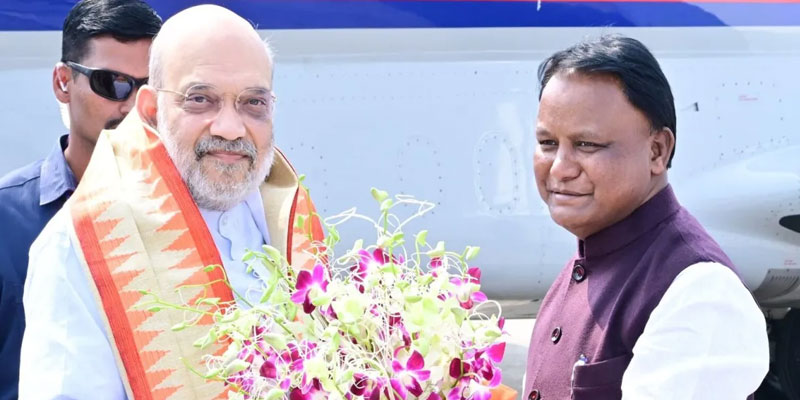
Union Home Minister Amit Shah arrived in Odisha on March 6, 2026, for a high-profile visit aimed at strengthening the state’s security infrastructure, forensic capabilities, and agricultural ecosystem. Welcomed at Biju Patnaik International Airport by Chief Minister Mohan Charan Majhi, Shah’s itinerary includes unveiling projects worth more than ₹3,300 crore.
The visit reflects the Centre’s renewed focus on expanding development and institutional capacity in eastern India following political changes in the state.
CISF Raising Day in Cuttack
Shah’s first engagement was at Mundali, where he attended the 57th Raising Day celebrations of the Central Industrial Security Force. The CISF plays a critical role in safeguarding strategic infrastructure such as airports, ports, power plants, and major public sector undertakings.
During the ceremonial parade, the Home Minister reviewed the force’s achievements and emphasized the need for heightened vigilance as India’s critical infrastructure expands. Local authorities carried out extensive preparations for the event, including road resurfacing, lighting upgrades, and beautification along the stretch between Godisahi and Mundali to facilitate smooth movement for the ceremony.
Fertilizer Boost at Paradip
Shah then travelled to Paradip to inaugurate the new Sulphuric Acid Plant-III at the Indian Farmers Fertiliser Cooperative Limited complex. The facility has a production capacity of 1,500 tonnes per day and is expected to significantly strengthen India’s domestic supply chain for phosphatic fertilizers.
By reducing dependence on imported inputs, the project supports the broader push for agricultural self-reliance while benefiting farmers across eastern India. State leaders highlighted that the expansion will also stimulate industrial activity in the coastal belt and generate employment opportunities in the region.
New Forensic and Justice Infrastructure
A major highlight of the visit was the foundation laying ceremony for campuses of National Forensic Sciences University and the Central Forensic Science Laboratory at Jatni, near Bhubaneswar. Shah also virtually inaugurated a transit campus of NFSU that will begin academic programs immediately while permanent infrastructure is built.
These institutions are expected to modernize the state’s investigative ecosystem by providing advanced training, research, and forensic analysis facilities within Odisha itself.
How the Projects Strengthen Odisha’s Forensic Capabilities
The establishment of a local CFSL will eliminate Odisha’s long-standing dependence on forensic labs in cities like Kolkata, Delhi, Hyderabad, and Gandhinagar for complex examinations.
Once operational, the Bhubaneswar laboratory will offer cutting-edge facilities for DNA analysis, ballistics, toxicology, and cyber forensics. This will significantly reduce the time required to process evidence—from months to just days—accelerating investigations and court proceedings.
Meanwhile, NFSU’s Bhubaneswar campus will introduce programs such as M.Sc. Forensic Science, M.Sc. Digital Forensics and Information Security, and LL.M. in Cyber Law. These courses aim to train police officers, investigators, and legal professionals to handle emerging crimes in the digital age.
The institutions will also support the implementation of new criminal legislation such as the Bharatiya Nyaya Sanhita, which emphasizes faster investigations and technology-driven evidence analysis.
Development with Strategic Impact
Amit Shah’s visit combines three critical pillars of governance—security, justice, and economic development. While the CISF event reinforces national security infrastructure and the IFFCO expansion supports farmers and industry, the new forensic institutions promise long-term benefits for law enforcement and the judicial system.
Together, these initiatives position Odisha as a growing hub for forensic science and investigative expertise in eastern India. If implemented effectively, the projects could strengthen policing efficiency, speed up trials, and contribute to a broader modernization of India’s criminal justice framework.
(With agency inputs)