In a significant step towards strengthening communication in remote and inaccessible regions, Bharat Sanchar Nigam Limited (BSNL) has launched a satellite phone priced at approximately ₹1.34 lakh. Unlike conventional smartphones that rely on mobile towers, the new device connects directly to satellites, enabling communication even in areas where terrestrial networks are unavailable. Designed primarily for emergency response, defence, maritime operations and remote industries, the satellite phone represents a strategic connectivity solution rather than a mass-market consumer product.
Bridging India’s Connectivity Gaps
Despite rapid expansion of mobile networks across the country, vast stretches of India—including mountainous regions, dense forests, border areas and offshore locations—continue to face limited or no cellular coverage. Natural disasters such as floods, earthquakes and cyclones can also disrupt conventional communication infrastructure, leaving affected areas isolated.
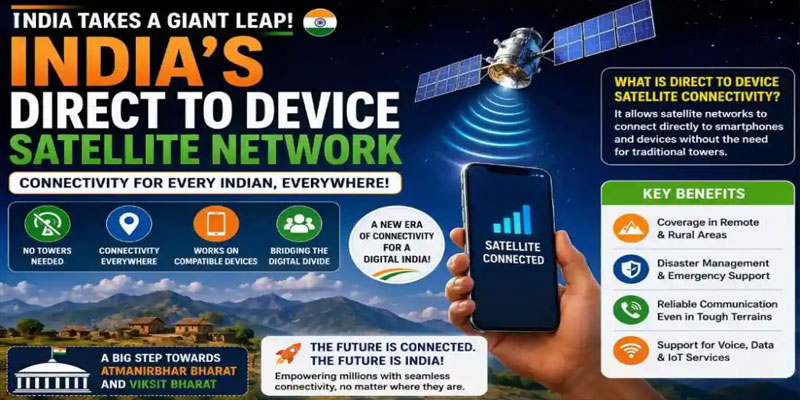
To address these challenges, satellite communication has emerged as an essential backup technology. Unlike traditional mobile services that depend on cell towers and fibre-optic networks, satellite phones maintain connectivity through satellites orbiting the Earth, ensuring communication even when ground infrastructure fails.
BSNL's latest offering reflects the government's broader objective of improving communication resilience and strengthening critical infrastructure for national security and disaster management.
How Does the BSNL Satellite Phone Work?
The BSNL satellite phone communicates directly with satellites using the Inmarsat satellite network, eliminating the need for nearby mobile towers. Once the handset establishes a connection with the satellite, voice calls, text messages and emergency communications are routed through satellite infrastructure before reaching conventional telephone networks.
This technology allows users to stay connected in remote mountains, deserts, forests, offshore waters, border regions and disaster-hit areas where ordinary mobile phones become unusable.
Because communication occurs through satellites rather than terrestrial networks, the phone provides a dependable communication channel even during large-scale network failures or infrastructure disruptions.
Key Features of the BSNL Satellite Phone
The satellite phone offers several features designed for mission-critical communication rather than everyday smartphone use. These include:
· Secure voice calling across satellite networks.
· SMS messaging in areas without cellular coverage.
· Dedicated SOS emergency support for distress situations.
· Location-based emergency communication to assist rescue and response operations.
· Reliable connectivity in isolated, high-risk and disaster-prone regions.
The emphasis is on uninterrupted communication, durability and operational reliability rather than internet speed or multimedia features typically associated with consumer smartphones.
Who Can Buy the BSNL Satellite Phone?
The satellite phone is primarily intended for organisations and professionals operating in locations where regular mobile connectivity is unreliable or unavailable.
Potential users include government departments, defence and security agencies, disaster response teams, maritime operators, mining companies, field engineers, infrastructure developers, logistics firms and businesses working in remote industrial areas. Adventure tourism operators and organisations conducting expeditions in isolated terrain may also benefit from the service.
While commercial users can purchase the device under separate service plans, its relatively high price makes it unsuitable for everyday urban consumers. Instead, BSNL is positioning the service as a specialised communication solution for business-to-government (B2G) and business-to-business (B2B) applications.
Strengthening India’s Communication Resilience
The launch of BSNL’s satellite phone marks an important advancement in India’s communication infrastructure. Although its premium pricing limits widespread consumer adoption, the device addresses critical gaps where uninterrupted communication can save lives, support security operations and ensure business continuity. As satellite communication becomes an increasingly important component of national infrastructure, BSNL’s initiative strengthens India’s preparedness for emergencies while improving connectivity in remote regions. By combining reliable satellite technology with strategic applications, the service has the potential to become an indispensable tool for disaster management, defence and essential services operating beyond the reach of conventional mobile networks.
(With agency inputs)