Electoral Roll Revision Sparks Political Uproar
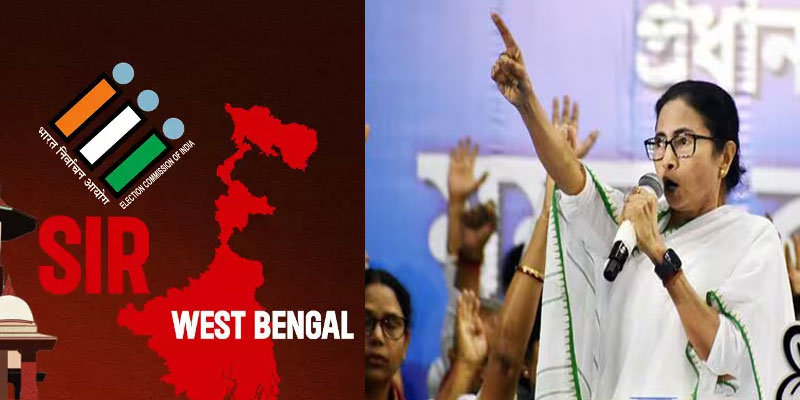
The Special Intensive Revision (SIR) of electoral rolls in West Bengal has triggered a wave of political confrontation, legal scrutiny, and public anxiety ahead of the high-stakes 2026 assembly elections. Intended as a comprehensive exercise to verify and update voter lists, the SIR has been sharply criticized by the ruling Trinamool Congress (TMC), with Chief Minister Mamata Banerjee branding it “votebandi” and accusing the Election Commission (EC) and the central government of attempting to influence the voter base. The unfolding controversy has now become central to Bengal’s pre-election climate.
Electoral Reform Meets Political Turbulence
Electoral roll revision is a routine administrative task, yet in West Bengal it has evolved into a political flashpoint. The SIR, theoretically a technical audit to strengthen electoral integrity, has instead heightened tensions between the state government and the Centre. The debate embodies Bengal’s polarized political environment, where even administrative processes acquire deep political meaning. As fears of voter exclusion grow, the SIR has emerged as a defining contest over trust, governance, and the robustness of democratic systems.
Understanding SIR: Purpose, Design, and Promise
The Special Intensive Revision is designed to eliminate duplicate entries, outdated records, and fraudulent identities using advanced tools, including AI-based facial recognition. The EC argues that such a clean-up is necessary for credible elections and reflects global best practices in electoral management.
In principle, SIR strengthens democracy by protecting the voting rights of legitimate electors and preventing manipulation of voter rolls. Conducted nationwide at regular intervals, it is meant to build voter confidence and curb electoral malpractices.
Mamata Banerjee’s Opposition: Fear of Voter Suppression
Mamata Banerjee has emerged as the most vocal critic of the SIR. She alleges that the drive will disproportionately affect marginalized communities, particularly minorities and Bengali Hindus, by risking wrongful deletion of genuine voters. Her framing of the SIR as “silent invisible rigging” suggests deep mistrust in the EC’s intentions and the central government’s role.
Banerjee argues that the process imposes undue burden on citizens and state employees, calling it a “super emergency” aimed at paralyzing governance. Her concerns also extend to possible data manipulation and large-scale technical errors, which could have long-term political consequences. The TMC’s protests and public warnings reflect its broader narrative of resisting central overreach and safeguarding democratic rights in the state.
Election Commission’s Position: Neutrality and Procedural Discipline
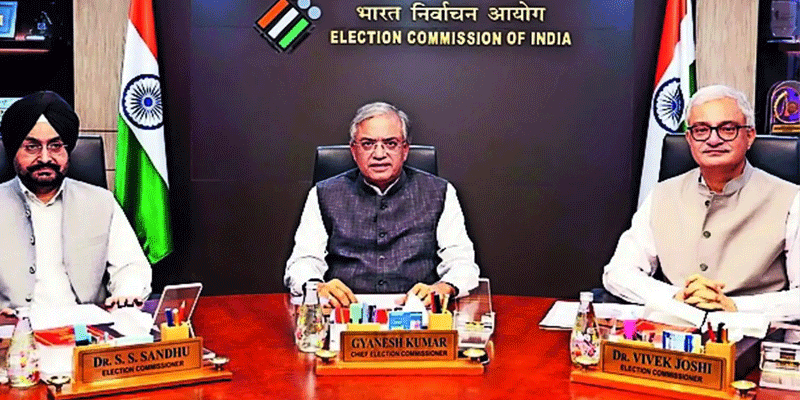
The EC maintains that clean and accurate voter rolls are its constitutional responsibility. It emphasizes transparency and due process, noting that similar revisions have succeeded in states like Bihar despite initial resistance. Special guidelines have been issued to curb irregularities, penalize administrative lapses, and ensure fair implementation.
Still, the commission faces significant logistical and political hurdles. Overburdened schoolteachers, technical inconsistencies, and miscommunication have complicated execution. The Supreme Court’s recent oversight signals judicial caution—supporting the need for credible rolls while ensuring that no legitimate voter is excluded.
Political Contestation and Broader Implications
While the TMC opposes the exercise, the BJP and other opposition parties defend it as essential to eliminating bogus voters and strengthening electoral transparency. They claim that the TMC’s objections stem from fear of reduced political leverage once the rolls are “cleaned.”
The controversy has deepened existing political rifts, framing the SIR not merely as an administrative exercise but as a symbolic confrontation between the state and the Centre. Its impact may extend beyond electoral rolls to influence communal relations, voter turnout, and public trust in democratic institutions.
Navigating the Path to Credible Elections
Experts argue that greater cooperation between state authorities and the EC is essential to restoring public confidence. Clear communication, upgraded logistical support, and transparent protocols can minimize errors and build trust. Parallel voter education campaigns may help citizens understand their rights and responsibilities, reducing anxiety and preventing inadvertent disenfranchisement.
A Stress Test for Bengal’s Democracy
The SIR debate encapsulates the complexities of electoral reform in a politically charged landscape. As the TMC and EC clash over motives, the credibility of the 2026 assembly elections hangs in the balance. Ultimately, the exercise—if implemented transparently—can strengthen democratic foundations. But its success depends on political maturity, administrative efficiency, and a shared commitment to ensuring that every legitimate voter’s voice is preserved.
(With agency inputs)