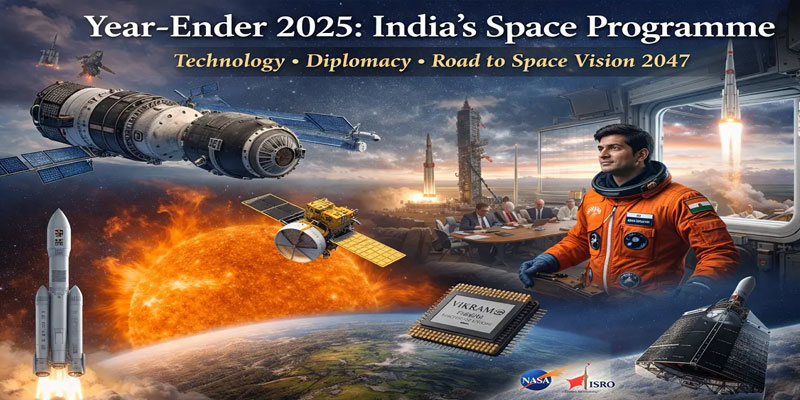
From achieving a historic landing near the Moon’s South Pole to preparing for human spaceflight and a national space station, India’s space programme is undergoing a profound transformation. What once appeared as a series of individual scientific missions is now evolving into a long-term strategy aimed at building a comprehensive space ecosystem. Anchored by ambitious projects such as Chandrayaan, Aditya-L1, Gaganyaan and the proposed Bharatiya Antariksh Station, India’s Space Vision 2047 reflects a broader goal: transforming the country into a leading space power while integrating space technologies into national development.
From Lunar Achievement to Capability Building
India’s modern space journey reached a defining moment with the successful landing of Chandrayaan-3 near the Moon’s south pole. The achievement elevated India into an exclusive group of nations capable of executing precision lunar landings, particularly in one of the most technically challenging regions of the lunar surface.
The success was followed by the launch of Aditya-L1, India’s first dedicated solar mission. By studying the Sun and space weather, the mission demonstrated the country's growing ability to conduct sophisticated deep-space scientific research.
Together, these missions signaled a shift in perception. India’s space programme is no longer recognized solely for cost-effective execution but increasingly for technological complexity, scientific depth and operational reliability.
The Next Frontier: Returning to the Moon
The coming decade promises even more ambitious lunar exploration. Chandrayaan-4, expected around 2027, aims to pursue a lunar sample-return mission. Such an undertaking requires multiple advanced capabilities, including landing, sample collection, ascent from the lunar surface, docking operations and safe return to Earth.
Further ahead, Chandrayaan-5, also known as the Lunar Polar Exploration Mission (LUPEX), is being developed in collaboration with Japan. The mission is expected to explore permanently shadowed regions near the Moon’s south pole, areas believed to contain water ice and other volatile resources that could prove critical for future lunar habitation and exploration.
Mangalyaan’s Enduring Legacy
India’s interplanetary ambitions were first demonstrated through Mars Orbiter Mission. The mission remains one of the country's most celebrated scientific accomplishments, making India the first nation to reach Mars orbit on its maiden attempt.
Beyond its symbolic significance, Mangalyaan showcased India’s ability to manage long-duration missions across deep space. The experience gained from spacecraft operations, navigation and resource management established a foundation of confidence that continues to support newer and more ambitious projects.
Preparing for Human Spaceflight
India’s human-spaceflight ambitions have accelerated significantly in recent years. The Axiom-4 mission in 2025 provided valuable operational experience through astronaut training, scientific experimentation and mission management.
This experience feeds directly into Gaganyaan, India’s first indigenous crewed mission. More than a symbolic achievement, Gaganyaan is designed to help India develop independent capabilities in astronaut training, life-support systems and human-rated space technologies.
The proposed Bharatiya Antariksh Station would represent the next stage, enabling long-duration scientific research and a sustained Indian presence in low Earth orbit.
Space as a Driver of National Development
Space Vision 2047 extends beyond exploration. The broader objective is to embed space technologies into governance, agriculture, healthcare, communications, disaster management and industrial growth. The rapid emergence of private space startups is further expanding India’s innovation ecosystem and reducing dependence on a single government agency.
From Participant to Space Power
India’s space programme is entering a new phase defined by continuity, capability and ambition. The progression from Chandrayaan and Aditya-L1 to Gaganyaan and the Bharatiya Antariksh Station illustrates a deliberate effort to create a self-sustaining space ecosystem. By combining scientific exploration, human spaceflight, international partnerships and private-sector participation, India is positioning itself not merely as a participant in the global space race but as a nation capable of shaping its future direction. If current momentum is sustained, Space Vision 2047 could mark the moment when India transitions from catching up to helping define the next era of space exploration and innovation.
(With agency inputs)