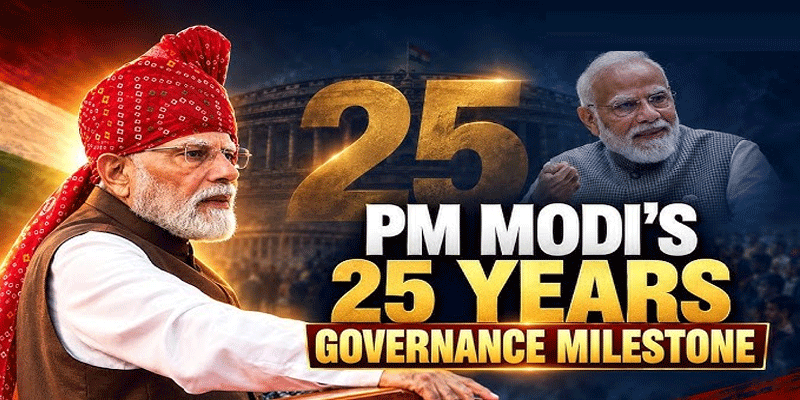
Prime Minister Narendra Modi has begun a three-nation tour of Indonesia, Australia and New Zealand to strengthen cooperation in security, trade, technology and the Indo-Pacific. The first leg of the visit has already yielded significant diplomatic and strategic gains, with India and Indonesia announcing 20 major outcomes, including 14 Memoranda of Understanding (MoUs) and six key bilateral announcements. The agreements span defence, critical minerals, healthcare, renewable energy, digital innovation, education and maritime security, signalling a decisive shift in bilateral ties from broad diplomatic engagement to implementation-driven strategic cooperation.
From Strategic Partnership to Concrete Collaboration
India and Indonesia elevated their relationship to a Comprehensive Strategic Partnership in 2018. While the framework laid the foundation for deeper cooperation, both countries have accelerated implementation in recent years amid evolving geopolitical and economic realities.
Growing concerns over supply-chain resilience, maritime security in the Indo-Pacific, critical mineral availability and technological diversification have brought New Delhi and Jakarta closer. Prime Minister Modi's discussions with Indonesian President Prabowo Subianto at Istana Merdeka were aimed at converting shared strategic interests into actionable partnerships capable of delivering long-term economic and security benefits.
Defence cooperation, including discussions surrounding the BrahMos supersonic cruise missile system, remains one of the most closely watched aspects of the relationship, reflecting growing trust between the two maritime democracies.
Visit Signals a Broader Strategic Vision
The most significant outcome of the visit is the expansion of cooperation beyond traditional diplomacy. India and Indonesia are now integrating defence, industrial development, healthcare, digital technologies, clean energy and critical mineral supply chains into a comprehensive strategic framework. The package of agreements also reinforces India's Act East Policy and its commitment to a free, open, inclusive and rules-based Indo-Pacific while strengthening engagement with ASEAN partners.
Major MoUs and Agreements Signed
The two countries announced a broad package of cooperation covering multiple sectors. The important MoUs and agreements include:
· MoU on minerals and steel supply-chain cooperation
· MoU on maritime safety and maritime security cooperation
· MoU on development of rare earth magnets
· MoU on healthcare cooperation
· MoU on pharmaceutical collaboration
· MoU on agriculture and food security
· MoU on digital technology and innovation
· MoU on space cooperation
· MoU on critical minerals processing and industrial collaboration
· MoU on renewable energy and green transition
· MoU on education and academic cooperation
· MoU on cultural exchanges and heritage cooperation
· MoU on defence-industrial cooperation, including progress on BrahMos discussions
· MoU on economic partnership, investment promotion and business-to-business engagement
In addition to these MoUs, both governments announced six broader initiatives aimed at strengthening institutional cooperation, facilitating implementation mechanisms and enhancing people-to-people exchanges.
Why These Agreements Matter
The agreements carry significance far beyond bilateral diplomacy. Defence cooperation complements industrial partnerships in critical minerals, creating stronger strategic supply chains for emerging technologies and clean-energy manufacturing.
Indonesia offers India greater strategic depth in Southeast Asia, improved maritime connectivity and access to vital mineral resources. In return, Indonesia benefits from India's expanding defence manufacturing capabilities, pharmaceutical expertise, digital innovation ecosystem and growing investment opportunities.
The broad sectoral coverage also reflects an effort by both countries to reduce dependence on single-source supply chains while building resilient economic partnerships.
Execution Will Define Long-Term Success
Prime Minister Modi's Indonesia visit marks an important milestone in India's Indo-Pacific diplomacy. The announcement of 20 concrete outcomes demonstrates that bilateral ties have entered a more practical and outcome-oriented phase. The extensive cooperation across defence, minerals, healthcare, technology, education and renewable energy provides a strong roadmap for future engagement. However, the true success of these agreements will depend not on the number of MoUs signed but on their timely implementation. If effectively executed, these partnerships could significantly strengthen India's strategic presence in Southeast Asia while creating lasting economic, technological and security benefits for both nations.
(With agency inputs)