Shock Entry Raises Fresh Security Concerns
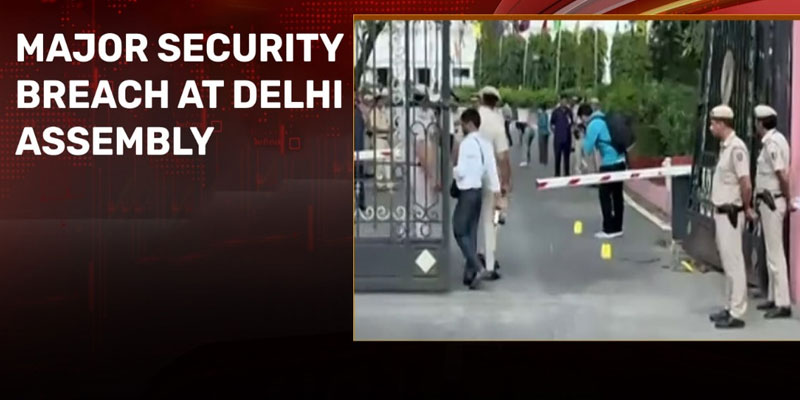
A major security breach unfolded at the Delhi Legislative Assembly on Monday when a car driven by a masked individual rammed through one of its gates, briefly entered the premises, dropped a bouquet, and exited without being stopped. The incident comes just days after bomb threats during the budget session, heightening concerns over the vulnerability of high-security government sites in the national capital.
What Happened Inside the Assembly Complex
According to officials, the vehicle—identified as a Tata Sierra with Uttar Pradesh registration—forced its way through Gate No. 2 around 2 PM, bypassing security personnel. The car reportedly moved towards the office of Speaker Vijender Gupta, where the driver left a bouquet before fleeing the premises.
Security teams, including a bomb disposal squad, immediately inspected the object but found no suspicious materials. While authorities have ruled out an immediate terror threat, the ability of the vehicle to enter and exit undetected has triggered a serious probe. CCTV footage and vehicle details are now being used to track the suspect.
Pattern of Repeated Security Breaches
This is not an isolated incident. High-security zones in Delhi have faced multiple breaches in recent years. The 2023 Parliament security scare involving smoke canisters prompted a major overhaul of protocols, including AI-based surveillance and enhanced response systems. Yet, similar lapses persist.
Past incidents include vehicles breaching Parliament barricades and recent acts of protest-related disruptions near the Assembly itself. Despite significant investments in security infrastructure, these repeated breaches highlight systemic weaknesses in access control and rapid response mechanisms.
Gaps in Security Protocols
The latest breach raises critical questions about the effectiveness of layered security systems. Standard protocols at such sites include multi-tier vehicle checks, armed guards, surveillance systems, and controlled entry points. However, the incident suggests lapses either in coordination, vigilance, or enforcement.
The fact that the vehicle remained inside the premises for several minutes without interception points to delayed response times. Experts argue that even non-lethal breaches can serve as reconnaissance for more serious threats, making such lapses particularly concerning.
Political Reactions and Broader Implications
The incident is likely to trigger political debate over law and order in the capital, especially with civic elections approaching. It also risks undermining public confidence in the ability of authorities to secure critical institutions.
Globally, similar breaches—such as the US Capitol riot—have shown how quickly security failures can escalate into larger crises. In Delhi, where protests and political activity are frequent, maintaining robust security is essential to prevent escalation.
A Wake-Up Call for Security Reinforcement
While the immediate threat appears contained, the breach serves as a stark reminder of vulnerabilities within even the most secure zones. Authorities must treat this as a warning and conduct a comprehensive review of security protocols, response systems, and accountability mechanisms. Strengthening vigilance and closing operational gaps will be crucial to ensuring that such incidents do not evolve into more serious threats in the future.
(With agency inputs)