A Conflict Rooted in History
Since their bitter partition in 1947, India and Pakistan have endured a relationship marred by wars, border skirmishes, and deep-rooted ideological divides. At the center of this decades-long conflict lies the disputed region of Jammu and Kashmir—claimed in full by both nations but administered separately. While New Delhi maintains that Kashmir is an integral part of India, Islamabad continues to project it as the core of its national identity.
Over the years, diplomatic efforts have repeatedly broken down due to terror attacks, ceasefire violations, and mutual distrust. And now, a fresh round of provocative rhetoric from the Pakistan military’s top leadership threatens to reignite the fragile balance.
Recent Provocation: General Munir's Hardline Message
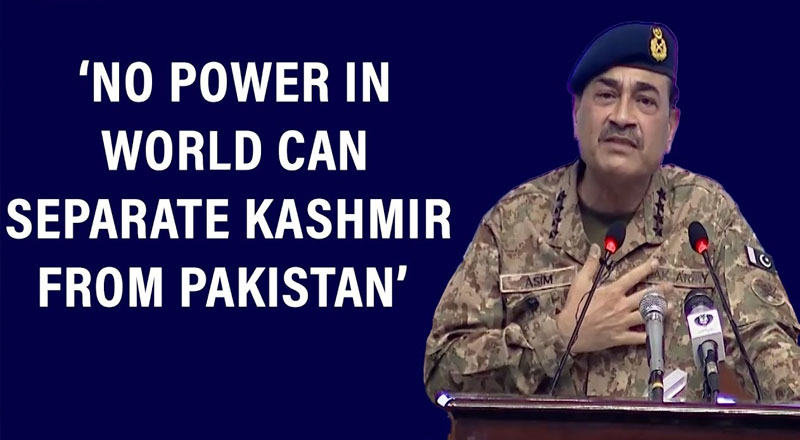
Speaking at a recent address to overseas Pakistanis, Pakistan Army Chief General Asim Munir stirred controversy by referring to Kashmir as Pakistan’s “jugular vein”—a term historically associated with aggressive Pakistani claims over the region. He asserted that Pakistan “will not forget” Kashmir, reinforcing Islamabad’s longstanding and unyielding position on the issue.
General Munir also used the platform to revive the contentious two-nation theory, the ideological cornerstone of Pakistan’s creation, stating: “Our forefathers thought that we are different from Hindus in every aspect of life—our religions, our customs, traditions, and ambitions. That was the foundation of the two-nation theory.”
He urged expatriates to instill a strong national identity in future generations, adding that Pakistanis belonged to a “superior ideology and culture” and must continue to champion the country’s legacy and beliefs.
Defending Identity, Fueling Division
General Munir’s comments go beyond mere symbolism. They underscore how the Pakistan Army continues to play an oversized role in shaping the country's ideological, political, and diplomatic narrative—often at odds with regional peace and dialogue.
While addressing concerns about terrorism and economic instability, the General emphasized the military's unwavering control, stating that: “If the 1.3 million-strong Indian Army cannot intimidate us, do you think terrorists can take away the destiny of this country?”
He also reaffirmed Pakistan’s commitment to crushing internal separatist movements, particularly in Balochistan, calling the province “Pakistan’s pride”, and asserting that attempts to destabilize it would fail, “even in ten generations.”
India Yet to Respond, But Tensions Likely to Rise
India’s Ministry of External Affairs has not issued an official response, but New Delhi has historically viewed such statements as deliberate provocations aimed at keeping the Kashmir issue alive on the international stage.
By reaffirming Kashmir’s centrality and invoking ideological divides, General Munir’s remarks may stall any nascent diplomatic thaw. His framing of the Kashmir struggle as “heroic” and the nation’s bond with it as eternal further cements Islamabad’s current stance under military influence.
Moreover, equating India and Pakistan as separate civilizations—not just countries—reopens historical wounds and rejects any vision of regional cooperation or shared heritage. It also reflects Pakistan’s ongoing identity crisis and its need to assert internal cohesion through external adversaries.
What Lies Ahead: Navigating a Fragile Future
General Munir’s speech signals no intent to recalibrate Pakistan’s traditional narrative on Kashmir or India. In fact, it reasserts the military’s dominance in shaping foreign policy—particularly at a time when Pakistan grapples with political instability, economic hardship, and rising security threats.
For India, the statements serve as a reminder of the enduring volatility in relations with its western neighbor. They may also prompt New Delhi to double down on its international messaging around Pakistan’s support for cross-border terrorism and its perceived failure to uphold democratic norms.
Looking forward, the diplomatic space for constructive engagement appears to be shrinking. Until Islamabad’s civil institutions take precedence over military rhetoric, and until both nations agree on a minimum framework of mutual respect and non-interference, the dream of lasting peace in South Asia will remain distant.
Rhetoric Over Reconciliation
General Munir’s hardline rhetoric reflects a strategic shift toward ideological reaffirmation rather than reconciliation. By invoking emotionally charged themes like Kashmir and the two-nation theory, Pakistan’s top general has made clear that old wounds remain open and unresolved.
As both nations prepare for crucial electoral cycles and regional power dynamics evolve, the focus must shift from provocation to pragmatic dialogue. Until then, Kashmir will continue to serve as both a symbolic battleground and a tragic reminder of a subcontinent divided.
(With inputs from agencies)
LATEST NEWS