The investigation into the alleged NEET-UG 2026 paper leak has deepened dramatically with the Central Bureau of Investigation (CBI) taking custody of Shubham Khairnar, a 30-year-old BAMS student from Nashik, Maharashtra. Detained earlier by Nashik Police following inputs from Rajasthan investigators, Khairnar is now at the center of a rapidly expanding multi-state probe involving Maharashtra, Rajasthan, Kerala, and Delhi.
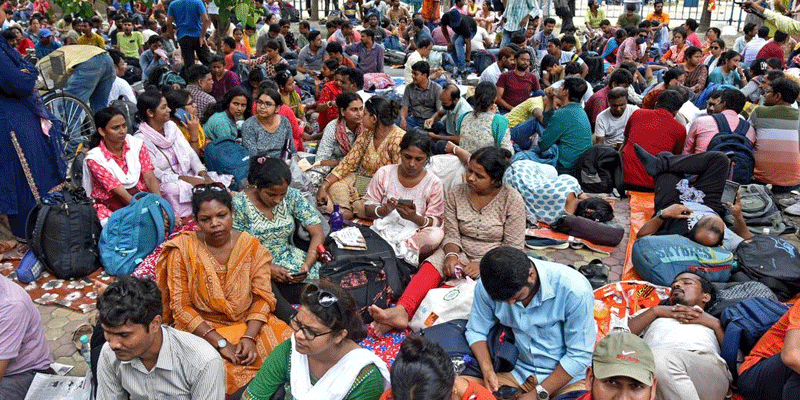
The development comes amid mounting outrage over the cancellation of one of India’s most important entrance examinations and growing concerns about the credibility of the National Testing Agency (NTA). NTA Director General Abhishek Singh stated that the schedule for the re-examination would be announced within the “next seven to 10 days,” while assuring candidates that no fresh registration or additional fees would be required.
The Expanding Multi-State Leak Network
According to investigators, the alleged paper leak was not an isolated incident but part of a sophisticated interstate operation involving coaching institutes, middlemen, counsellors, and encrypted digital communication channels.
Kiran Kumar Chauhan revealed that Rajasthan Police had alerted Nashik authorities after handwritten “guess papers” linked to the leak surfaced in Sikar district shortly before the May 3 examination. Investigators believe the material may have originated in Kerala before circulating through an organized network across multiple states.
The scale of the alleged compromise has shocked authorities. Probe agencies claim that nearly 125 to 140 questions from the leaked material matched the final NEET-UG paper, potentially accounting for around 600 marks out of the total 720. In several cases, even answer option sequences reportedly matched exactly.
Investigators suspect that question papers were sold at varying rates ranging from ₹20,000 to as high as ₹22 lakh, depending on the level of access. Some versions allegedly circulated on encrypted WhatsApp groups just hours before the examination.
CBI Steps in as Probe Intensifies
The CBI has reportedly constituted four separate teams to investigate different aspects of the conspiracy. Officials are examining whether Khairnar played a coordinating role in distributing leaked papers and facilitating access to candidates through coaching networks and hostel accommodations.
The Rajasthan Special Operations Group (SOG) continues parallel investigations and has already questioned multiple suspects. More arrests are expected as agencies attempt to trace the full chain of communication and identify the masterminds behind the operation.
Authorities are also investigating how such a large-scale breach involving one of India’s most competitive examinations escaped detection before the exam was conducted.
Political Reactions Trigger Nationwide Debate
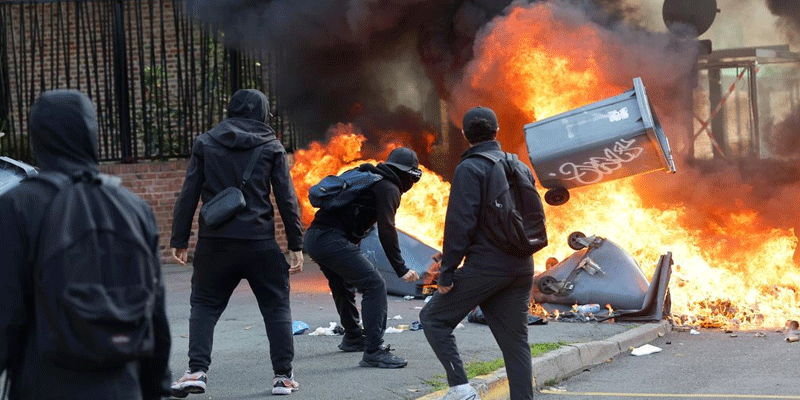
The controversy has sparked fierce political reactions across party lines, transforming the issue into a national debate over educational integrity and institutional accountability.
M. K. Stalin strongly criticized the examination system, calling NEET “a scam” and demanding complete cancellation of the test. Left parties, including the CPI and CPI(M), described the leak as evidence of systemic institutional failure and demanded the dismantling of the NTA itself.
Student organizations such as the Akhil Bharatiya Vidyarthi Parishad demanded an impartial investigation and strict action against examination mafias. Opposition leaders accused the BJP-led central government of repeatedly failing to protect the futures of nearly 22 lakh aspirants appearing for competitive examinations.
A Crisis of Credibility in India’s Examination System
The NEET-UG 2026 leak investigation has evolved into far more than a criminal inquiry; it has become a national reckoning over the integrity of India’s competitive examination framework. With millions of students affected, public trust in centralized testing systems now faces unprecedented strain. While the CBI’s aggressive multi-state probe signals institutional seriousness, the larger challenge lies in rebuilding confidence among students and parents who view examinations as gateways to opportunity. The coming weeks will determine not only the fate of the accused but also the credibility of India’s educational governance itself.
(With agency inputs)