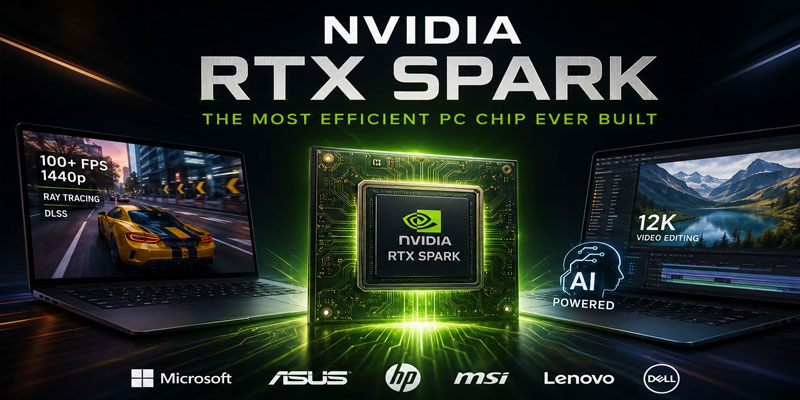
NVIDIA is fundamentally rethinking how personal computers are designed. At its GTC Taipei event, the company introduced RTX Spark, a new chip architecture that integrates high-performance graphics, processing power, and advanced AI capabilities into a single, unified system.
The platform combines a 20-core Grace CPU with Blackwell RTX graphics and supports up to 128GB of unified memory. This combination delivers up to 1 petaflop of AI performance, placing desktop-level AI power into a more compact and efficient form factor than traditional setups.
Developed in partnership with MediaTek, the technology is already powering Microsoft’s Surface Laptop Ultra, which launched on October 16. This real-world deployment signals that NVIDIA’s vision is moving quickly from concept to consumer devices.
Unlike conventional PCs, where the CPU and GPU rely on separate memory pools that slow down data transfer, RTX Spark allows components to share memory seamlessly. The result is faster processing, lower latency, and significantly improved efficiency for AI-driven tasks.
NVIDIA has made clear that this architecture is not intended to replace traditional desktop graphics cards used by gamers and creators. Instead, it aims to push mainstream personal computers toward more integrated, AI-centric designs that can handle emerging workloads more effectively.
The shift reflects a broader industry trend in which artificial intelligence is no longer an add-on feature but a core requirement for future computing. By embedding powerful AI performance directly into the system, NVIDIA is preparing everyday devices for a new era of intelligent applications.
With RTX Spark, NVIDIA is not just releasing another chip—it is laying the foundation for personal computers that think, process, and adapt far more intelligently than anything that came before.