How the Centre Plans to Clean Up the Yamuna
In a major push to rejuvenate the dying Yamuna River, the Centre has rolled out a comprehensive 30-point action plan that engages six government agencies across Delhi and the central government. The initiative, emerging from a high-level meeting chaired by Prime Minister Narendra Modi on April 16, seeks to address not just the river’s pollution crisis but also the broader issue of Delhi’s drinking water security.
The roadmap includes enhancing environmental flow (E-flow), plugging untreated drains, constructing new sewage treatment plants (STPs), solid waste management, riverfront development, and even floodplain restoration. Timelines for these projects span from mid-2025 to early 2029, signaling a long-term vision with tight oversight.
Why It’s Urgent: A River Turned Drain and a Political Battleground
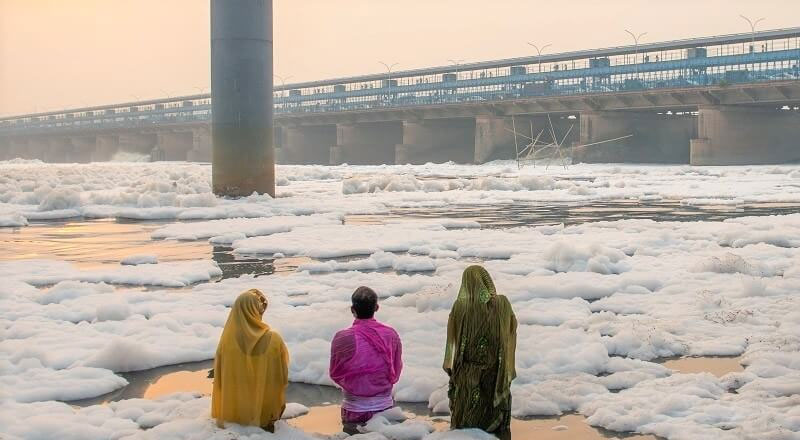
Once revered and life-giving, the Yamuna today resembles an open sewer as it winds through Delhi. With nearly 80% of its pollution attributed to untreated domestic sewage, industrial effluents, and solid waste dumping, the river is now emblematic of decades of failed promises and fragmented governance.
Cleaning the Yamuna has long been a political plank. The Congress-led UPA government-initiated river clean-up missions, while the Aam Aadmi Party (AAP) government in Delhi made cleaning the Yamuna central to its urban agenda. Despite spending over ₹8,500 crore in the last decade, the river remains choked and biologically dead within the city’s boundaries.
The BJP, now steering both the Centre and the Delhi municipal corporation, has politicized the failure of its rivals, branding AAP’s efforts as “AAP-DA” (a play on “disaster”). The Yamuna clean-up now features prominently in BJP’s campaign for the 2025 Delhi Assembly elections—highlighting a pivot from rhetoric to action, under central leadership.
Breaking Down the 30-Point Plan
The plan aims to integrate environmental restoration with infrastructure development and administrative enforcement. Here are key components:
- Enhancing E-Flow: By September 2026, around 773 million litres per day (MLD) of treated water from STPs at Coronation Pillar and Yamuna Vihar will be released downstream of Wazirabad. Additionally, 6.23 cumecs of treated water from the Okhla STP will flow into the river post-Okhla barrage.
- Boosting Treatment Capacity: Delhi will see the addition of 500 MLD of sewage treatment capacity by 2029, with new STPs planned at Shastri Park, Delhi Gate, and Kailash Nagar. These will plug untreated discharges from key drains.
- Drains and Colonies: 1,799 unauthorized colonies will be connected to the sewage network, and major drains—such as Barapullah, Sonia Vihar, and Mori Gate—will be tapped, treated, and monitored before discharge.
- Floodplain Protection and Riverfront Development: Echoing Ahmedabad’s Sabarmati model, the BJP-led Centre envisions transforming Yamuna’s banks into vibrant public spaces with commercial hubs, entertainment venues, and walkways. DDA will spearhead this under a newly proposed “Yamuna Kosh” (Yamuna Fund).
- Surveillance and Governance: The Central Pollution Control Board (CPCB) will coordinate with Delhi Jal Board (DJB) and MCD to track polluters, enforce penalties, and oversee real-time water quality data using surveillance technologies.