

India’s Quantum Future May Begin in Amaravati
Quantum computing is no longer a distant possibility—it is rapidly becoming the next technological revolution. As global giants like Google and IBM push the boundaries of quantum research, Andhra Pradesh is positioning itself at the forefront of this emerging field. The state envisions Amaravati as the “Quantum Valley” of India—much like Hyderabad became a hub for cloud computing—marking a bold ambition to lead the country’s next digital transformation.
The National Mission
India’s push into quantum technology is anchored in the National Quantum Mission (NQM), launched in 2023 with an outlay of over ₹6,000 crore. The mission aims to develop indigenous quantum capabilities across computing, communication, sensing, and advanced materials.
Institutions such as Indian Institute of Science and other research hubs are working toward building quantum systems ranging from 50 to 1,000 qubits. The goal is not just academic research but practical applications in areas like cryptography, drug discovery, and artificial intelligence. This comes amid a global race, where companies like Google have demonstrated error-corrected qubits, while IBM is pursuing large-scale quantum processors.
Amaravati’s Quantum Push: Building a ‘Quantum Valley’
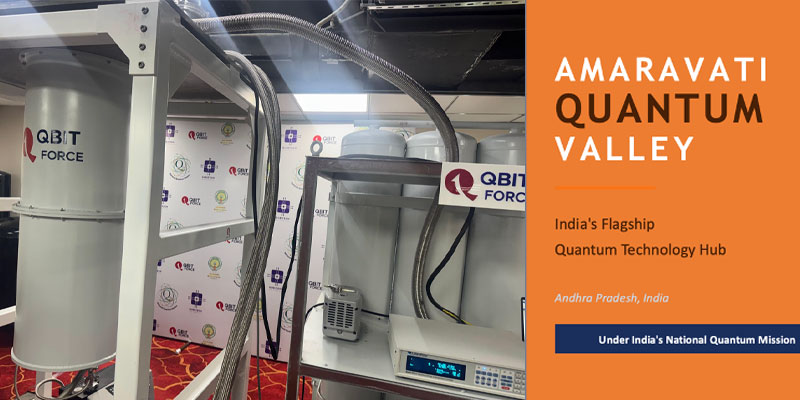
On April 14, 2026, Andhra Pradesh took a significant step by launching India’s first indigenous quantum reference facility—the Amaravati Quantum Reference Facility (AQRF)—at SRM University AP. Inaugurated by Chief Minister N. Chandrababu Naidu, the facility includes advanced testbeds such as Amaravati 1S and 1Q.
The AQRF is designed as an open-access platform for testing quantum components, including processors and cryogenic systems. The state plans to develop a 50-acre quantum campus by 2031, aiming to create a full ecosystem for design, testing, and manufacturing.
Strategic partnerships are central to this vision. Agreements with IBM, Tata Consultancy Services (TCS), and Larsen & Toubro (L&T), along with collaboration involving over 80 partners—including research institutions, startups, and defense organizations—are helping build a robust innovation network.
Preparing for the Quantum Leap
Andhra Pradesh is actively investing in talent and innovation to support its quantum ambitions. Initiatives include hackathons, skill development programs, and incentives such as a ₹100 crore reward for groundbreaking research. Thousands of students and professionals are being trained to build a future-ready workforce.
The state also aims to integrate quantum technology with sectors like defense, healthcare, and semiconductors. By aligning with national priorities and global trends, Amaravati is positioning itself as a hub that bridges research and real-world applications.
Challenges on the Road Ahead
Despite its ambitious roadmap, significant challenges remain. One of the biggest hurdles is the shortage of skilled professionals. India will require tens of thousands of quantum experts, and current training programs are still catching up with global standards.
Infrastructure is another major barrier. Quantum systems require highly specialized environments, including expensive cryogenic cooling and advanced fabrication facilities. Building such infrastructure demands massive investments, often running into billions.
Competition from other states like Telangana and Gujarat, along with global dominance by countries such as the United States and China, adds to the pressure. Additionally, technical challenges—such as reducing error rates and scaling quantum systems—remain unresolved worldwide.
A High-Stakes Bet on the Future
Andhra Pradesh’s quantum push reflects a forward-looking strategy to position itself at the cutting edge of technology. By combining policy support, industry partnerships, and infrastructure development, the state is making a serious bid to lead India’s quantum revolution.
However, success will depend on sustained investment, talent development, and the ability to overcome technological and logistical barriers. If executed effectively, Amaravati could indeed emerge as India’s Quantum Valley—shaping not just the state’s future, but the country’s place in the global tech landscape.
(With inputs from agency)