
A Historic Departure from Earth
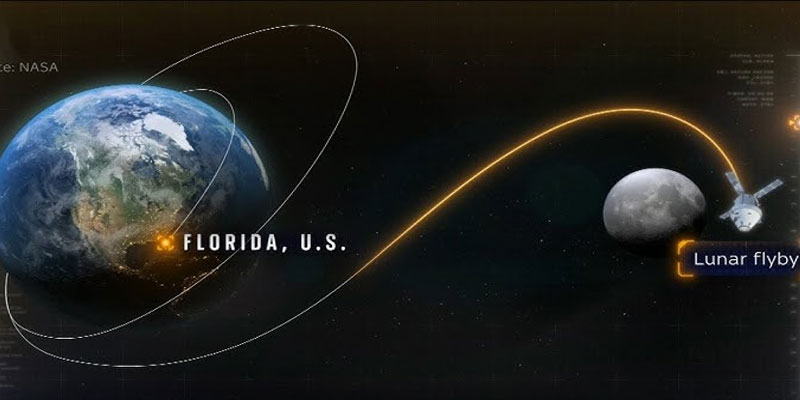
NASA’s Artemis II mission has officially begun its journey to the Moon, marking a defining moment in modern space exploration. The Orion capsule successfully executed a near-perfect translunar injection (TLI) burn—a critical six-minute engine firing that propelled it out of Earth’s orbit and onto a lunar-bound trajectory. This precise maneuver, generating around 6,000 pounds of thrust, signals humanity’s return to deep space for the first time since Apollo 17 in 1972. With four astronauts onboard, Artemis II is not just a mission—it is a statement that human spaceflight beyond low Earth orbit is back.
The Science of the Journey
Following the TLI burn, Orion is now coasting toward the Moon on a carefully calculated path. The spacecraft relies largely on Newton’s first law of motion, requiring minimal propulsion except for small course corrections. This approach conserves fuel and demonstrates the efficiency of deep-space navigation.
The mission is designed around a “free-return trajectory,” meaning that even without further intervention, the spacecraft would loop around the Moon and safely return to Earth. This built-in safety feature underscores the mission’s dual purpose: pushing boundaries while maintaining robust safeguards for the crew.
The Lunar Flyby: A Critical Milestone
Around the sixth day of the mission, Artemis II will perform a close lunar flyby, bringing the crew within approximately 6,400 kilometres of the Moon’s surface. This will be the closest humans have come to the Moon in over five decades.
The flyby is not merely symbolic—it serves as crucial systems test under real mission conditions. Astronauts will observe the Moon’s far side, a region never before seen directly by human eyes in full sunlight during a crewed mission. The experience is expected to provide both scientific insights and a powerful visual reminder of humanity’s expanding frontier.
Risks and Realities of Deep Space
Despite its precision, the mission is not without risks. During the lunar flyby, Orion will enter a communications blackout lasting up to 50 minutes as the Moon blocks direct contact with Earth. This temporary loss of communication highlights the challenges of deep-space operations, where distance and celestial mechanics impose unavoidable constraints.
Such moments test not only technology but also human resilience. Artemis II is as much about validating systems as it is about preparing astronauts for the psychological demands of operating far from Earth.
A Strategic and Scientific Leap
Beyond its technical achievements, Artemis II carries significant strategic weight. It reaffirms NASA’s capability to send humans into deep space and lays the groundwork for future missions, including Artemis III, which aims to land astronauts on the lunar surface later this decade.
The mission also signals a broader shift toward sustained lunar exploration, with implications for international collaboration, resource utilization, and eventual missions to Mars. In this sense, Artemis II is both a continuation of past ambitions and a launchpad for future ones.
A New Era Takes Flight
The successful translunar injection of Artemis II marks the beginning of a new chapter in human space exploration. By combining precision engineering, strategic foresight, and human ambition, the mission bridges the gap between Apollo’s legacy and the future of deep-space travel. As Orion continues its silent journey toward the Moon, it carries with it not just astronauts, but the promise of a renewed human presence beyond Earth—one that could redefine our place in the universe.
(With agency inputs)