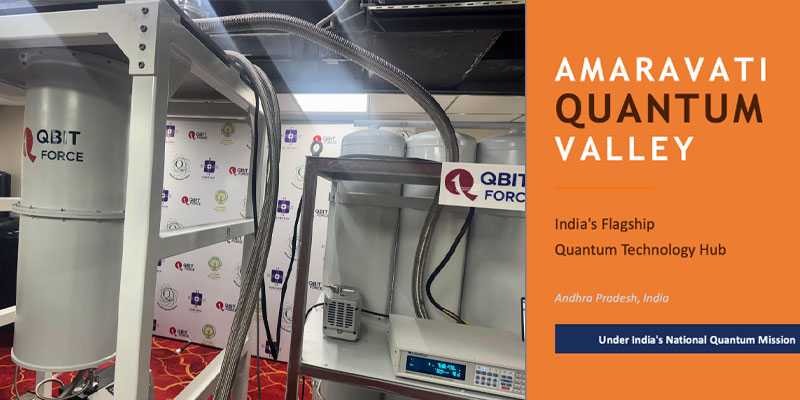
Andhra Pradesh has marked a major milestone in India’s technological journey with the launch of the country’s first indigenous Quantum Testing Reference Facility in Amaravati on April 14, coinciding with World Quantum Day. Spearheaded by Chief Minister N. Chandrababu Naidu, the initiative reflects a strategic shift from theoretical research toward practical quantum hardware development and ecosystem creation, positioning Amaravati as a rising hub for advanced computing.
A key highlight of this development is the launch of India’s first open-access quantum characterization lab, built by QBit Force under the leadership of Dr. Venkata Subramaniam. The facility is designed to support superconducting qubits, cryogenic systems, and advanced materials research. Qubitech will operate the lab, managing research activities and training programs to nurture future talent in quantum technologies.
The project features two state-of-the-art quantum testbeds: 1S, located at SRM University in Amaravati, and 1Q, based at Medha Towers in Gannavaram. Both are integral to the larger Quantum Valley initiative, a 50-acre development at Uddandarayunipalem envisioned as a comprehensive center for quantum research, testing, and manufacturing.
A defining strength of the initiative lies in its “Make in India” approach, with over 80% of components developed domestically. These systems operate at near absolute zero temperatures (−273°C) and incorporate advanced technologies such as dilution refrigerators, amplifiers, and locally designed processors. This reduces reliance on imports while strengthening India’s self-reliance in quantum hardware.
Aligned with Andhra Pradesh’s Quantum Computing Policy (2025–30) and the national NM-QTA mission, the project aims to build a full-stack quantum ecosystem. Future plans include a 133-qubit quantum computer in collaboration with global and domestic partners, further enhancing India’s capabilities in next-generation computing.
The facilities follow an open-access model, allowing researchers, startups, academic institutions, and government agencies to test hardware and develop quantum algorithms. This approach encourages innovation in real-world applications such as healthcare, logistics, and optimization challenges.
Beyond technology, the initiative is expected to deliver significant economic and workforce benefits, including high-skilled job creation and large-scale training programs targeting thousands of professionals. With strong policy backing, global collaborations, and a clear long-term vision, Amaravati is poised to emerge as a global quantum innovation hub, contributing to breakthroughs in areas like cryptography, drug discovery, and aerospace.