War That Redefined Gaza
The war between Israel and Hamas, now stretching into its second year, has devastated Gaza and reshaped the regional landscape. The conflict began in October 2023 when Hamas fighters crossed into southern Israel, killing around 1,200 people and taking more than 250 hostages. Israel’s military response was overwhelming—an offensive that has destroyed much of the enclave, displaced nearly its entire 2.2 million residents, and claimed more than 64,000 Palestinian lives, according to Gaza’s health authorities.
While some hostages have been freed during temporary ceasefires, dozens remain in Hamas custody. Israel has vowed not to stop until Hamas is dismantled, while Hamas insists it will not disarm unless an independent Palestinian state is created. Against this backdrop, the latest military escalation in Gaza City underscores both the fragility of negotiations and the intensifying humanitarian catastrophe.
Evacuation Orders and Public Fear
On Tuesday, the Israeli military ordered residents of Gaza City—home to roughly a million people—to evacuate before what it described as a new ground “maneuver.” Prime Minister Benjamin Netanyahu issued a stark warning: “You have been warned—get out of there.”
The announcement triggered panic and confusion. Many families began preparing to flee south to Al-Mawasi in Khan Younis, an area Israel has designated as a humanitarian zone. Yet, for many, leaving offered little comfort. Gaza’s residents have already been displaced multiple times since the war began, often moving back and forth between the north and south as frontlines shifted. Others insisted they would stay, believing no place in the territory is truly safe.
Israel’s Threat of a “Mighty Hurricane”
Israel’s Defense Minister Israel Katz warned that if Hamas refuses to release the remaining hostages, the military will escalate operations with what he called a “mighty hurricane.” Netanyahu confirmed that troops were mobilizing for deeper maneuvers into Gaza City, though no fresh advances by tanks were reported on Tuesday.
Israel says Hamas is entrenched in the city’s remaining strongholds, making Gaza City central to its strategy of dismantling the group. But each step of the offensive risks further complicating ceasefire diplomacy and worsening civilian suffering.
Ceasefire Hopes and Diplomatic Pressure
Efforts to halt the fighting have centered on a U.S.-backed proposal for a hostage-for-ceasefire arrangement. Qatar has been pressing Hamas to respond positively to Washington’s ideas, and U.S. President Donald Trump recently suggested a deal could be imminent. Israel has indicated it has accepted the framework, though key details remain unresolved.
Hamas, for its part, says it has received “ideas” from mediators but maintains it will not surrender or disarm without guarantees of Palestinian statehood. The deadlock continues even as international pressure mounts, with several European countries signaling support for recognizing Palestinian statehood at the upcoming UN General Assembly—a step Israel rejects.
Humanitarian and Political Fallout
The scale of destruction and displacement has generated global criticism. International agencies have declared famine in parts of Gaza, where nearly 400 people—mostly children—have died of hunger and malnutrition in the past two months alone. Israel disputes these figures, claiming deaths are exaggerated or caused by other factors, but independent verification is impossible as Israel blocks foreign reporters from entering Gaza. Nearly 250 Palestinian journalists have been killed, making this the deadliest conflict for media workers in modern times.
Inside Israel’s government, the war is intensifying political pressures. Netanyahu insists Israel must “finish the job” by defeating Hamas, but critics argue his strategy risks isolating the country diplomatically. Plans to impose permanent Israeli security control over Gaza and demilitarize the strip are viewed by many international observers as unworkable and potentially destabilizing.
Life Amid the Rubble
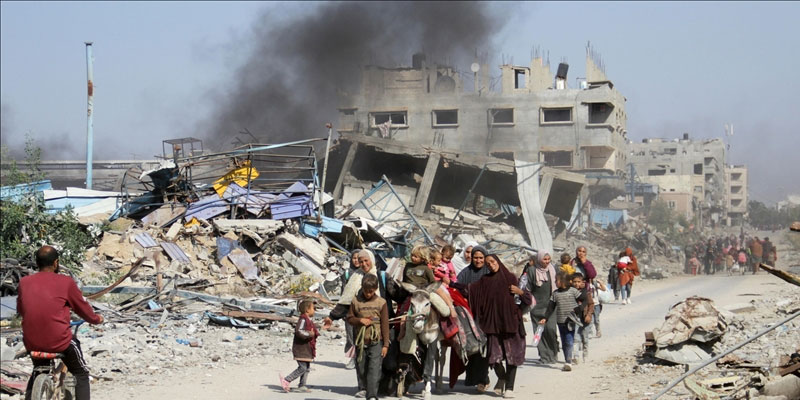
For those still inside Gaza City, daily life is marked by bombardments, shortages, and despair. Recent Israeli strikes targeted neighborhoods such as Sheikh Radwan, Zeitoun, and Tuffah, destroying clusters of homes and killing at least 12 people, including journalist Osama Balousha. Residents live in ruins, with little access to food, medicine, or clean water.
The human toll continues to climb. Each new offensive displaces more families, amplifying the suffering of a population already enduring unimaginable hardship.
Between Military Goals and Human Survival
Israel’s evacuation orders and threats of a “mighty hurricane” highlight the war’s grim trajectory. For Israel, destroying Hamas remains a strategic imperative. For Hamas, holding hostages and demanding recognition of Palestinian statehood remains its bargaining chip. In between lies a civilian population paying the highest price—displaced, starved, and living under the shadow of relentless bombardment.
Diplomatic mediation offers the only path to halt the bloodshed, but progress has been slow and fragile. Without a breakthrough, Gaza risks further collapse, and Israel risks entrenching a conflict that has already redrawn the region’s political and humanitarian map.
The war began with a shocking assault in 2023, but its continuation threatens to define an entire generation on both sides. Lasting peace will require more than military victories or temporary ceasefires—it will demand political courage, recognition of legitimate aspirations, and a shared commitment to prevent Gaza from becoming a perpetual battlefield.
(With agency inputs)