Strengthening Defence Through ‘Make in India’
In a landmark decision that underlines India’s push for self-reliance in defence manufacturing, the government has cleared a ₹62,000-crore project to procure 97 indigenously built Tejas Mark 1A fighter aircraft for the Indian Air Force (IAF). The move not only boosts the country’s military preparedness but also aligns with Prime Minister Narendra Modi’s Make in India and Atmanirbhar Bharat campaigns, where indigenous defence platforms are central to reducing dependency on imports.
Second Major Order for Tejas
This fresh approval is the second large-scale order for Tejas Mark 1A jets after an earlier contract for 83 aircraft worth ₹48,000 crore. Together, these procurements represent a significant leap in strengthening India’s aerospace ecosystem. The fighter jets, produced by Hindustan Aeronautics Limited (HAL), are set to replace the ageing MiG-21 fleet, which has been operational for decades but is now being phased out.
Technological Upgrades and Indigenous Edge
The Mark 1A variant of the Tejas comes with enhanced avionics, advanced radars, and improved electronic warfare systems compared to the initial 40 Light Combat Aircraft (LCA) supplied to the IAF. Significantly, the indigenous content in these aircraft is projected to cross 65 percent — a major stride towards building self-sufficiency in aerospace technology. Defence officials emphasize that the programme is more than a procurement plan; it is a blueprint for India’s long-term aeronautical innovation and capability.
Boost for HAL and the Defence Ecosystem
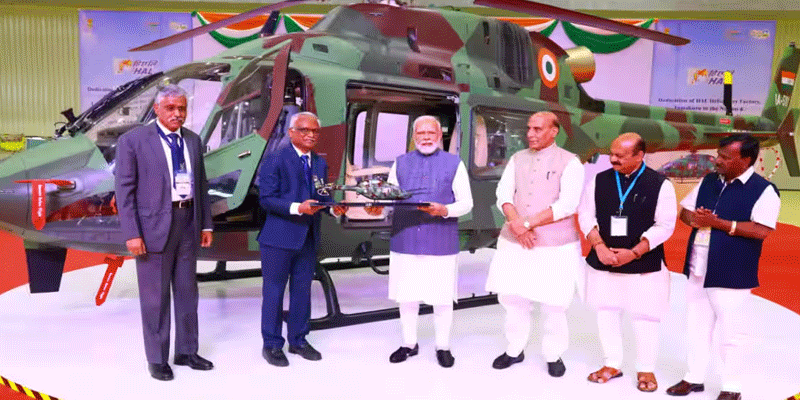
HAL, the country’s premier state-run aerospace manufacturer, is the principal beneficiary of this mega order. Over the past few years, the government has actively sought to revive HAL, awarding it contracts across the spectrum — from fighters and helicopters to engines. The Tejas deal will not only ensure HAL’s robust production lines but also generate business opportunities for small and medium enterprises (SMEs) engaged in supplying components and systems. This ripple effect is expected to strengthen the defence industrial base across the country.
Political and Strategic Significance
Prime Minister Narendra Modi has been a vocal advocate for India’s indigenous fighter aircraft programme. His symbolic sortie in the trainer variant of the Tejas marked the first time an Indian Prime Minister flew in a combat aircraft, underscoring the government’s commitment to homegrown defence solutions. Strategically, the induction of additional Tejas aircraft signals India’s determination to modernize its air force fleet with domestically produced systems while reducing reliance on costly foreign imports.
From Announcement to Approval
The plan for 97 new jets was initially revealed by former Air Chief Marshal V.R. Chaudhari during an interaction in Spain, where he underlined the IAF’s intent to expand the indigenous fleet. Tuesday’s approval formalizes those plans, giving HAL the green light to accelerate production. Sources note that this order is part of a broader roadmap that includes over 200 Tejas Mark 2 aircraft and the development of India’s fifth-generation Advanced Medium Combat Aircraft (AMCA).
A Step Towards Self-Reliance in Defence
For decades, India’s air power has relied heavily on imported aircraft. While acquisitions from Russia, France, and the U.S. continue to form part of the IAF’s inventory, the Tejas project reflects a decisive turn toward self-reliance. The programme has become the flag-bearer of Atmanirbhar Bharat, embodying the nation’s aspiration to design, manufacture, and sustain its own fighter jets.
A Turning Point in Aerospace
The approval of 97 additional Tejas Mark 1A jets is more than just a defence contract; it is a milestone in India’s pursuit of technological sovereignty. With modern avionics, growing indigenous content, and large-scale industrial participation, the Tejas programme promises to transform India’s aerospace landscape. If executed with precision and efficiency, this initiative could not only replace ageing fleets but also position India as a global player in fighter aircraft manufacturing — marking a true step forward in the vision of a self-reliant nation.
(With agency inputs)