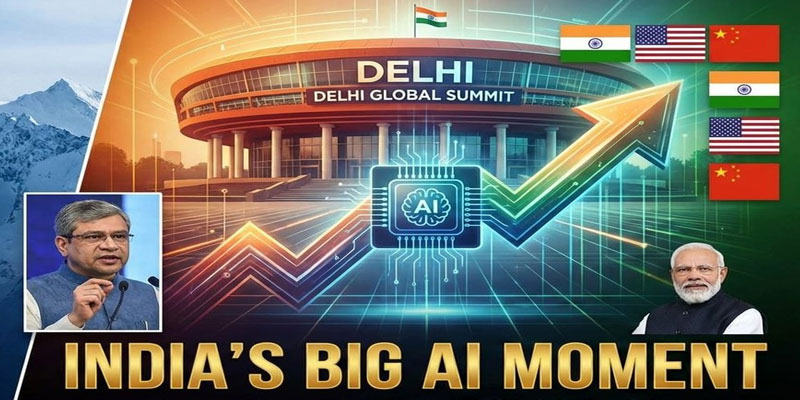
The India AI Impact Summit 2026, currently underway in New Delhi from February 16-20, represents a pivotal moment for India's artificial intelligence ambitions. This five-day gathering—the first global AI summit hosted in the Global South—brings together over 20 heads of state, 60 ministers, and 500 global AI leaders to shape the future of AI governance and innovation .
Summit Overview and Scale
Prime Minister Narendra Modi inaugurated the summit on February 16 at Bharat Mandapam, framing India's vision under the guiding principle of "Sarvajana Hitaya, Sarvajana Sukhaya"—welfare for all, happiness for all . The summit has drawn unprecedented participation, with an estimated 250,000 visitors expected across its five-day duration .
| Key Summit Facts | Details |
|---|---|
| Dates | February 16-20, 2026 |
| Location | New Delhi (Bharat Mandapam, Sushma Swaraj Bhawan) |
| Heads of State | 20+ participating |
| Ministerial Delegations | 45+ countries |
| Global AI Leaders | 500+ attendees |
| Startups | 600+ participating |
| Exhibitors | 300+ from 30 countries |
Leadership and Vision
In his opening remarks, PM Modi emphasized that India "stands at the forefront of the AI transformation," crediting the nation's 1.4 billion people, expanding digital public infrastructure, and vibrant startup ecosystem for this momentum . He toured the AI Impact Expo, visiting pavilions including Reliance Jio's, where Akash Ambani showcased AI platforms spanning healthcare, local-language technologies, education, and smart homes .
The summit reflects India's ambition to position itself not merely as a consumer market but as a key platform in the global AI debate—one that can offer scalable, affordable AI solutions rooted in the experiences of the developing world .
Guiding Framework: Three Sutras and Seven Chakras
The summit is anchored in three foundational pillars or 'Sutras'—Sanskrit terms meaning guiding principles that weave together wisdom and action :
-
People: AI-enabled solutions empowering citizens through expanded healthcare access, personalized education, and secured financial systems
-
Planet: AI enabling smarter, sustainable practices in agriculture through crop prediction, precision farming, and drone-based monitoring
-
Progress: AI strengthening governance through language translation, improved service delivery, and enhanced everyday efficiency
Building on these Sutras, deliberations are structured around seven thematic 'Chakras' representing key areas of multilateral cooperation :
-
Human Capital: Building equitable AI reskilling ecosystems
-
Inclusion for Social Empowerment: Enabling inclusive participation through shared AI solutions
-
Safe and Trusted AI: Translating global principles into practical governance frameworks
-
Resilience, Innovation and Efficiency: Addressing environmental and resource challenges
-
Science: Harnessing AI to accelerate discovery while correcting inequities
-
Democratizing AI Resources: Ensuring equitable access to foundational AI enablers
-
AI for Economic Growth & Social Good: Recognizing high-impact use cases that serve both growth and social good
Global Participation and Key Figures
The summit has drawn world leaders including French President Emmanuel Macron and Brazilian President Luiz Inácio Lula da Silva, who are holding bilateral talks with PM Modi on the sidelines . Macron's visit, scheduled from February 17-19, includes participation in the AI Impact Summit as well as a bilateral summit in Mumbai focused on defense cooperation and the India-France Year of Innovation 2026 .
Tech industry participation is equally impressive, with OpenAI CEO Sam Altman, Google CEO Sundar Pichai, Microsoft President Brad Smith, Qualcomm CEO Cristiano Amon, and Yann LeCun among the attendees . Notably, NVIDIA CEO Jensen Huang canceled his planned attendance due to unforeseen circumstances .
Flagship Global Impact Challenges
Three flagship competitions have generated remarkable global interest, collectively receiving over 4,650 applications from more than 60 countries :
AI for ALL Global Impact Challenge
-
Applications: Over 1,350 from 60+ countries
-
Focus: Scalable AI solutions in healthcare, agriculture, climate resilience, governance, education, and financial inclusion
-
Finalists: 20 teams with solutions including AI-driven infection screening, soil intelligence systems, climate risk analytics, and digital health diagnostics
AI by HER Global Impact Challenge
-
Applications: Over 800 from 50+ countries
-
Focus: Women-led AI innovation
-
Finalists: 30 women entrepreneurs working on AI-powered cancer screening, multilingual clinical decision support, voice-to-EMR platforms, and credit intelligence systems
YUVAi Global Youth Challenge
-
Target: Young innovators aged 13-21
-
Partners: Implemented with MyBharat and NIELIT
The top 70 finalists are presenting their solutions at the Grand Finale and Awards Ceremony on February 16-17 at Bharat Mandapam and Sushma Swaraj Bhawan, with awards up to ₹2.50 crore .
Day-by-Day Highlights
Day 1 (February 16): PM Modi's inauguration, panel discussions on AI for National Defence, Cybersecurity Strategy in the AI Era, and "People's AI: Designing a Future Where Everyone Belongs"
Day 2 (February 17): High-level panels on "AI for Social Good: Impact that Works," "Scaling Impact from India's Sovereign AI and Data," and "Innovation to Impact: AI as a Public Health Gamechanger." Launch of flagship Knowledge Compendiums including Casebooks on AI in Health, Energy, Education, Agriculture, Gender Empowerment, and Disabilities
Day 3-4 (February 18-19): Macron's participation in leaders' plenary and working lunch on February 19 ; continued thematic sessions on employability, data-driven road safety, and resilient agriculture
Day 5 (February 20): Concluding sessions and summit outcomes
India's AI Ecosystem and Achievements
The summit showcases India's comprehensive approach to AI development through initiatives including :
-
IndiaAI Mission: Building robust AI compute infrastructure
-
Indigenous AI models: Promoting homegrown solutions
-
Capacity-building programs: Large-scale skilling initiatives
-
Regional AI Conferences: Eight conferences held between October 2025-January 2026 across states including Meghalaya, Gujarat, Odisha, Madhya Pradesh, Uttar Pradesh, Rajasthan, Kerala, and Telangana
| Sectoral AI Applications in India | Examples |
|---|---|
| Healthcare | Remote diagnostics, AI-powered telemedicine, medical image analysis for TB/cancer detection, predictive disease outbreak analytics |
| Agriculture | Weather prediction, pest outbreak forecasting, AI-powered drone monitoring, market price prediction, Kisan E-Mitra and Mossum GPT tools |
| Education | Personalized learning platforms, AI-powered language translation, DIKSHA platform, 24/7 tutoring systems |
| Finance | Fraud detection, AI-based credit scoring, banking chatbots, personalized financial products |
| Governance | AI-assisted translation of court judgments, smart city management, streamlined service delivery |
Global South Leadership and Partnerships
As the first Global South nation to host this summit, India is positioning itself as a bridge for emerging economies . Leaders from Indonesia, Uganda, and Ghana have highlighted the summit's importance for mutual learning and regulatory alignment.
Kautsarina Adam from Indonesia's Ministry of ICT noted: "This summit provides mutual recognition and agreement on our shared efforts. We aim to adopt AI to boost our economy and global partnerships" .
Irene Karungi Sekitoleko from Uganda's Ministry of ICT emphasized: "Uganda is developing governance frameworks... We seek to learn from countries like India on scaling solutions, adapting them to local contexts" .
Maxwell Ababio from Ghana's Data Protection Commission observed: "India is doing well, a lot has been learned, and more collaboration is needed" .
Challenges and Critiques
Despite the ambitious agenda, some experts express caution. Amba Kak, Co-Executive Director of the AI Now Institute, warned that previous AI summits resulted in "limited 'self-regulatory' frameworks that allow AI companies to self-assess their own performance" . The question remains whether participating nations will take meaningful steps to hold AI giants accountable .
Some participants also note that the summit's broad thematic scope—spanning from employment impacts to child safety—may dilute the potential for concrete commitments .
Additionally, like previous editions in France, the UK, and South Korea, the India AI Impact Summit is not expected to produce a binding political agreement, but rather a non-binding pledge or declaration on AI development goals .
Employment Concerns and Reskilling
India faces genuine concerns about AI's impact on jobs across technology and allied sectors. However, experts emphasize reskilling as the primary mitigation strategy. Sangeeta Gupta, Senior Vice President at Nasscom, noted: "There is a lot of genuine concern around this theme... From an Indian lens, emphasis is on re-skilling programs. As AI becomes much more mainstream, you will also see newer job roles coming up" .
What This Week Tests for India
This week represents a critical test for India's AI ambitions across several dimensions:
-
Diplomatic leadership: Can India successfully convene diverse Global South and developed nations around a shared AI vision?
-
Governance framework: Will the summit produce actionable commitments beyond rhetoric?
-
Investment attraction: Can India position itself as an attractive destination for AI investment and innovation?
-
Inclusive development: Will the emphasis on "People, Planet, Progress" translate into tangible benefits for India's citizens?
-
Global positioning: Does this summit cement India's role as a key architect of AI's future rather than merely a market?
Looking Ahead
PM Modi is scheduled to deliver the inaugural address on February 19, setting the tone for enhanced global cooperation and advancing India's vision for inclusive, trusted, and development-oriented artificial intelligence .
The AI Compendium, released during the summit, will serve as a reference resource documenting real-world AI applications across priority sectors, supporting continued collaboration beyond the summit .
As the summit continues through February 20, the world watches whether India can translate its ambitious vision into concrete outcomes that benefit not just its 1.4 billion citizens, but the broader global community seeking an AI future that is "progressive, innovative and opportunity-driven