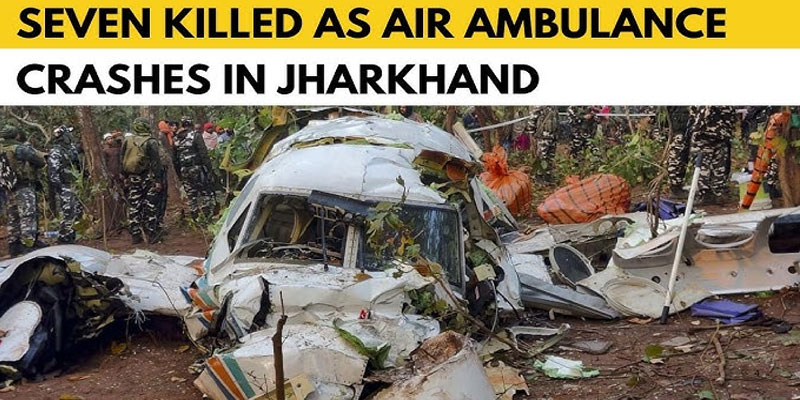
A medical evacuation meant to save a life ended in catastrophe on February 23, 2026, when a Beechcraft C90 air ambulance crashed in Jharkhand’s Chatra district, killing all seven people onboard. Operated by Redbird Airways Pvt Ltd, the aircraft had departed from Birsa Munda Airport at 7:11 pm en route to Delhi with a critically burned patient. Radar contact was lost just 23 minutes later, and the aircraft went down in a forested area near the Chatra–Ranchi border amid poor weather conditions.
The crash has sent shockwaves across the country, not only because of the loss of life but because it underscores the precarious balance between urgency and safety in India’s rapidly expanding air ambulance sector.
A Family’s Desperate Bid to Save a Life
The ill-fated flight was chartered by the family of 42-year-old Sanjay Kumar Shaw, who had suffered 60% burns in a house fire two days earlier. With advanced treatment required at Safdarjung Hospital, his relatives reportedly borrowed Rs 7.5 lakh—draining savings and taking loans—to fund the emergency airlift.
Onboard were Shaw’s wife Archana Devi, a relative, the attending doctor and nurse, and two experienced pilots. All perished instantly in the crash. The tragedy has left Shaw’s two children orphaned and a grieving family burdened not only by loss but by debt.
The emotional and financial gamble highlights a broader inequity: access to advanced medical care often hinges on private chartered services that are expensive and logistically complex.
Crash Sequence and Investigation
Preliminary data suggests the twin-engine turboprop climbed normally after take-off before encountering convective weather activity and low visibility over Jharkhand’s hilly terrain. Villagers reported hearing a loud explosion around 7:40 pm, with debris scattered across a 200-meter radius.
Teams from the Directorate General of Civil Aviation (DGCA) and the Aircraft Accident Investigation Bureau (AAIB) have initiated a probe. Early assessments point to thunderstorms and possible wind shear as contributing factors, though investigators are examining flight recorders for mechanical or operational anomalies.
Night operations in challenging weather conditions—especially for medical evacuations under pressure—raise questions about decision-making thresholds and real-time weather intelligence.
Redbird Airways and Regulatory Scrutiny
Redbird Airways, a non-scheduled operator with certification for charter and air ambulance roles since 2023, operates a small fleet including two Beechcraft C90 aircraft. While the 35-year-old aircraft reportedly held valid certifications and the pilots had over 5,000 hours of combined flying experience, this marks the company’s second incident following a 2024 runway excursion.
Aviation experts are now examining whether weather briefings were sufficiently robust and whether operational protocols for medical evacuations—often conducted under immense time pressure—require stricter oversight.
Implications for India’s Air Ambulance Ecosystem
India’s air ambulance market, valued at roughly $150 million annually, handles over 50,000 missions each year. Yet regulatory gaps persist. Although reforms in 2023 mandated dual pilots and advanced life-support equipment, issues such as pilot fatigue norms, real-time meteorological integration, and standardized instrument flight requirements remain under debate.
The crash renews calls for DGCA-mandated weather minimums tailored specifically for medevac flights, improved terrain awareness systems, and greater public-sector participation to reduce reliance on high-cost private charters.
When Urgency Meets Systemic Fragility
The Jharkhand air ambulance tragedy is more than an aviation accident—it is a stark reminder of the human stakes embedded in emergency medical logistics. Families in crisis often make extraordinary financial sacrifices, trusting that speed will mean survival.
As investigations unfold, accountability must extend beyond immediate causes to systemic reform. Strengthening oversight, improving weather intelligence, and expanding affordable public medevac infrastructure are essential steps. In missions defined by mercy, safety cannot be negotiable.
(With agency inputs)