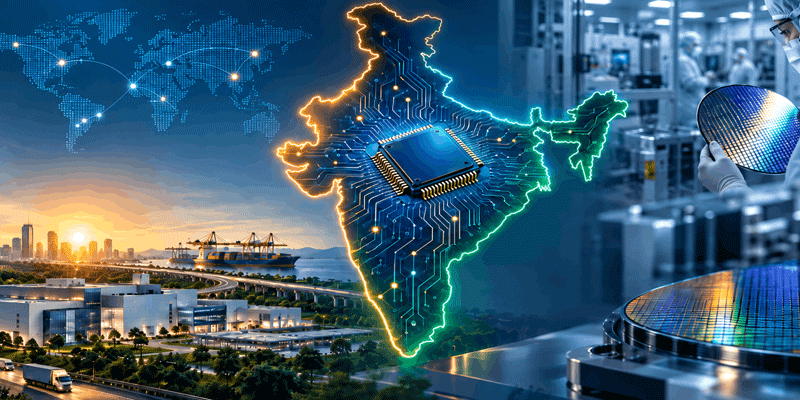
India’s semiconductor vision is entering a decisive phase as its first chip facilities move towards commercial-scale production. The central message emerging from Semicon 2026 is that building fabs alone will not create a globally competitive semiconductor industry. India must simultaneously develop hundreds of domestic companies spanning chip design, equipment, materials, specialty gases, chemicals and components.
From Semiconductor Mission to Full-Scale Ecosystem
India’s semiconductor push has moved rapidly from policy announcements to manufacturing execution. Under the India Semiconductor Mission, three plants, including Micron’s assembly, testing, marking and packaging facility in Gujarat, have moved into commercial production, while additional projects are progressing.
The completion of the first phase has prompted a broader policy transition. ISM 2.0, approved in July 2026 with an allocation of ₹1.27 lakh crore over 12 years, expands the focus beyond fabrication and design to equipment, raw materials, chemicals, gases, research and development and large-scale talent development.
Semicon 2026 Shifts Focus to Localisation
Discussions at Semicon 2026 in New Delhi highlighted the economics and complexity of semiconductor manufacturing. L&T Semiconductor Technologies CEO Sandeep Kumar pointed to gross margins potentially reaching 50–70% while stressing that substantial reinvestment is required to remain competitive and develop successive generations of products.
His broader argument was significant: with more than 20,000 semiconductor products globally, India cannot depend on a handful of companies. A successful ecosystem could require hundreds of specialised domestic firms serving different technological and industrial niches.
Gases, Chemicals and Components Become Critical
Industry leaders increasingly see semiconductor inputs as the next major localisation frontier. Merck Electronics CEO Benjamin Hein emphasised that fabs require reliable supplies of ultra-pure chemicals and gases, supported by stringent safety, handling and certification standards.
INOX Air Products is already manufacturing around 12 semiconductor gases domestically and plans to add another 10. Its ₹500-crore expansion includes gas-purification capacity, logistics and packaging, including an Electronic Specialty Gas Hub at Dholera.
Kaynes Semicon has identified lead frames, moulding compounds and bonding wire as important localisation opportunities, with these inputs collectively accounting for a significant share of manufacturing costs.
What India Could Gain
A deeper ecosystem could reduce import dependence while creating an export-oriented manufacturing network around fabs. It could also attract investment into equipment, materials and specialised industrial services, generating skilled employment beyond semiconductor plants themselves.
Technologically, domestic production of critical inputs would encourage better process engineering, quality certification and R&D. With India’s semiconductor demand projected to rise sharply through 2029–30, capturing a larger share of that growth will require capabilities across the entire value chain.
From Building Fabs to Building Semiconductor India
The central takeaway from Semicon 2026 is that India’s semiconductor strategy is entering its second and more demanding stage. Fabs provide the foundation, but a resilient industry requires the companies, suppliers, researchers and skilled workforce surrounding them. If ISM 2.0 successfully converts investment interest into domestic capabilities, India could gradually evolve from a chip-assembly destination into a comprehensive semiconductor ecosystem capable of competing in global supply chains.
(With agency inputs)