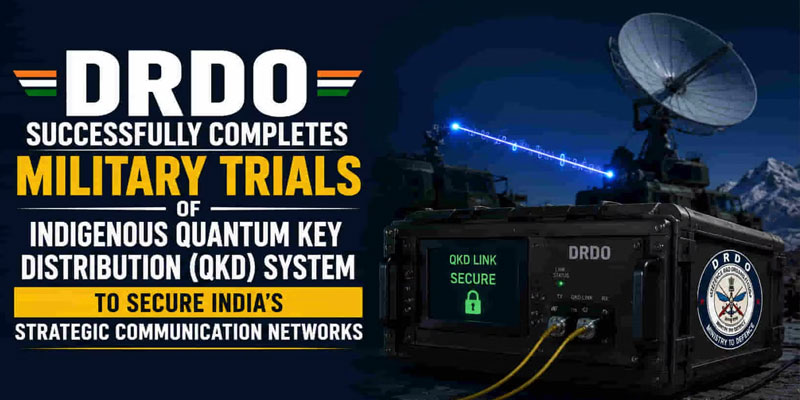
The Defence Research and Development Organisation (DRDO) has successfully tested a Quantum Key Distribution (QKD) platform on a live military test-range network, marking a significant step towards strengthening India’s defence communications against cyber threats. Conducted at Chandipur in Odisha, the trial demonstrates the potential to protect sensitive weapons-testing data using quantum-based security technology.
From Laboratory Research to Operational Defence
The latest trial builds on earlier field testing conducted by DRDO and Bengaluru-based Taqbit Labs in July 2026. That exercise evaluated a scalable, fibre-based QKD system intended to support secure military communications across multiple network nodes.
The new demonstration integrated the platform into the operational network of the Proof and Experimental Establishment (PXE) at Chandipur, where dynamic test ranges support trials of artillery and armoured weapon systems.
These facilities generate sensitive telemetry and real-time observations concerning weapon performance. If intercepted, such information could expose critical technical parameters and compromise operational security. Testing quantum-secured communication in this environment therefore represents an important step towards practical defence applications.
How Quantum Key Distribution Protects Communications
Unlike conventional encryption systems, QKD uses quantum principles to distribute cryptographic keys between authorised parties. It does not encrypt the underlying data by itself; instead, it provides a secure mechanism for establishing encryption keys.
Its central advantage is that attempts to intercept or measure quantum states can introduce detectable disturbances. When eavesdropping is detected, the communicating parties can reject compromised keys and establish fresh ones.
This capability is particularly relevant as advances in quantum computing could eventually threaten widely used public-key cryptographic systems.
Properly implemented QKD can help protect key distribution against such threats, although overall security still depends on the complete system, including hardware, authentication and network implementation.
Indigenous Technology Strengthens Defence Self-Reliance
The collaboration supports India’s efforts to develop indigenous quantum-security capabilities and reduce dependence on foreign technologies for strategically sensitive communications.
The use of a live test-range network is especially significant because it helps evaluate practical integration, reliability and interoperability beyond controlled laboratory conditions.
From Test-Range Protection to Strategic Networks
The immediate application is safeguarding weapons-test telemetry and range communications. Future possibilities include command-and-control systems, strategic installations and interconnected defence communication networks.
However, challenges remain. Fibre-based QKD has distance limitations, requires secure infrastructure and may depend on trusted intermediate nodes for long-distance communication.
Securing India’s Defence Against Tomorrow’s Threats
The Chandipur demonstration marks meaningful progress towards quantum-secured military infrastructure. The real strategic advantage will emerge when indigenous quantum technologies evolve from successful trials into reliable, scalable systems protecting India’s most sensitive defence communications.
(With agency inputs)