A Spectacular Reveal Ahead of Earnings
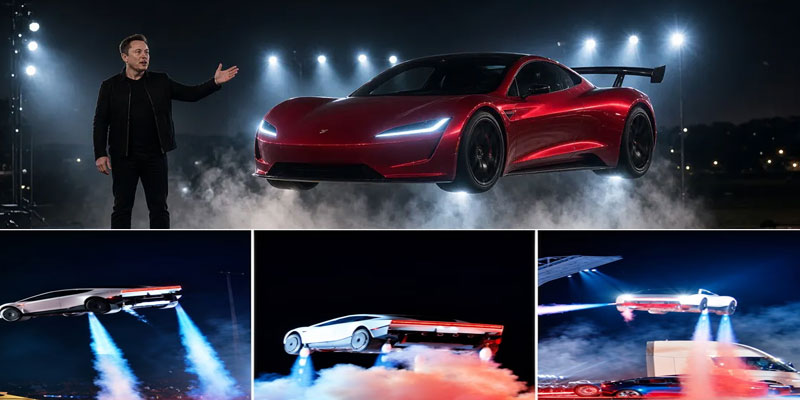
Tesla’s redesigned Roadster, equipped with SpaceX-developed thrusters capable of brief airborne manoeuvres, has captured attention with a dramatic demonstration that blurs the line between an electric sports car and rocket technology. However, despite the spectacle, commercial production is not expected to begin until 2028, extending a wait of more than a decade since the next-generation model was first unveiled in 2017.
The reveal comes just days before Tesla’s October 21 third-quarter earnings report, placing the futuristic vehicle at the centre of attention as investors assess the company’s growth prospects.
What Tesla Demonstrated
At an event held at SpaceX’s testing facility in McGregor, Texas, a white two-seater Roadster drove up a curved ramp, travelled upside down using a suction system, flipped in mid-air and landed with assistance from its thrusters. It subsequently jumped over a truck and other vehicles while performing airborne manoeuvres.
Tesla engineering vice-president Lars Moravy said the vehicle uses 10 thrusters supplied by 600 litres of compressed air. Elon Musk described it as the “world’s first flying car,” although the demonstration showed brief jumps rather than sustained flight.
The technology aims to push the boundaries of acceleration and vehicle performance, but questions remain about safety, road legality and practical everyday use.
A High-Risk Bet on Extreme Performance
Tesla positions the Roadster as a halo product designed to showcase its engineering capabilities rather than compete directly with mass-market electric vehicles. The company claims top-tier versions could accelerate from zero to 60 mph in under 0.6 seconds and exceed 230 mph.
Yet several critical details remain undisclosed, including pricing for thruster-equipped versions, regulatory approval requirements and the practical limitations of using compressed-air propulsion on public roads. Musk has also cautioned that “success is not guaranteed,” acknowledging the uncertainty surrounding the ambitious project.
Tesla’s Spectacle Strategy
The Roadster reveal reflects Tesla’s broader strategy of using ambitious technological demonstrations to sustain public interest while reshaping its business around autonomy and robotics.
The company is expanding its focus beyond conventional electric vehicles through projects such as the Cybercab robotaxi and Optimus humanoid robots. Tesla has also announced plans to repurpose manufacturing capacity for robotics, signalling a shift in long-term priorities.
Meanwhile, Tesla reported 486,532 vehicle deliveries in the third quarter, alongside 13.7 gigawatt-hours of energy-storage deployments. The delivery rebound offers encouragement, but competition and pressure on its core electric-vehicle business remain important challenges.
Investors Await Commercial Proof
Tesla shares reportedly rose around 4% following the Roadster reveal, reflecting enthusiasm for the company’s technological ambitions. However, the demonstration alone cannot establish whether the vehicle will generate meaningful revenue or improve near-term profitability.
Investors will look for evidence in the October 21 earnings report that Tesla can convert its futuristic projects into commercially viable businesses.
From Spectacle to Success: The Real Test Ahead
The thruster-powered Roadster reinforces Tesla’s identity as a company willing to challenge conventional automotive engineering. But extraordinary demonstrations must eventually translate into reliable products, regulatory compliance and sustainable commercial returns. Until production timelines, pricing and practical applications become clearer, the Roadster remains a technological promise rather than a market-ready breakthrough. Tesla’s ultimate challenge is to ensure that its spectacle strategy delivers more than headlines: it must produce measurable progress in manufacturing, profitability and long-term growth.
(With agency inputs)