Indian media groups have challenged the government’s privacy law in the Supreme Court, warning that its provisions could undermine investigative journalism, expose confidential sources and threaten the publication of public-interest reports. The dispute raises a fundamental question: how can India protect citizens’ personal data without restricting the media’s ability to hold those in power accountable?
Why Publishers Have Approached the Supreme Court
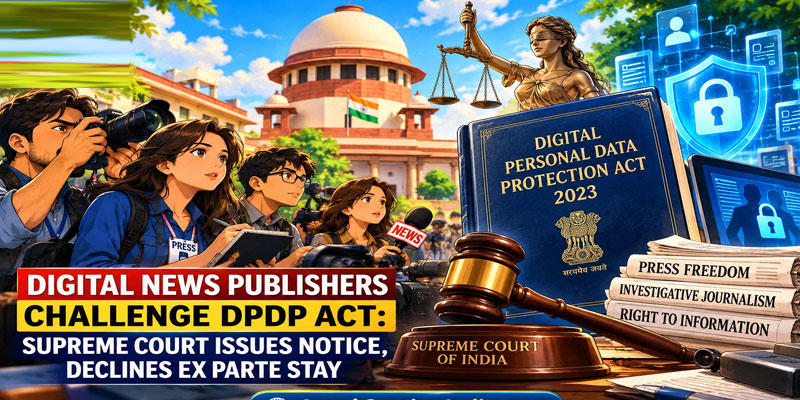
A coalition of 21 major news publishers, led by the Digital News Publishers Association (DNPA), has challenged provisions of the Digital Personal Data Protection (DPDP) Act, 2023. The law’s implementation framework is scheduled to take full effect from May 2027, according to the supplied account.
The publishers argue that the legislation does not provide a specific exemption for journalism. They fear its consent, notice, data-erasure and disclosure requirements could make reporting involving personal information legally difficult and financially risky.
Senior advocate Madhavi Divan argued that requiring journalists to obtain consent from individuals before reporting on them could create a system of pre-censorship.
Privacy Versus Freedom of Expression
The constitutional dispute centres on two important rights: privacy, recognised as a fundamental right in the Supreme Court’s 2017 K.S. Puttaswamy judgment, and freedom of speech and expression under Article 19(1)(a).
The publishers challenge several provisions, including Sections 7, 17(2), 27, 36, 37 and 44(3), arguing that the legislation lacks adequate safeguards for public-interest journalism. The Supreme Court must determine whether the restrictions are constitutionally proportionate.
How the RTI Amendment Raises Stakes
Section 44(3) amends Section 8(1)(j) of the Right to Information Act, 2005, concerning access to personal information held by public authorities. Critics argue that the amendment weakens the previous public-interest safeguards.
This could affect investigations into government contracts, property ownership, public appointments, regulatory decisions and alleged conflicts of interest. If relevant information becomes harder to obtain, journalists and citizens could face additional obstacles in scrutinising public institutions.
What Happens Next in Court?
On October 27, 2026, the Supreme Court issued notice to the Centre on the publishers’ petition and listed the matter for November 17. It did not immediately suspend the challenged provisions. The outcome could determine whether India introduces clearer protections for journalistic sources, archives and reporting conducted in the public interest.
Protecting Privacy Without Silencing Accountability
India needs robust data protection, but privacy must not become a blanket shield against legitimate scrutiny. The Supreme Court’s challenge is to establish safeguards that protect individuals while allowing journalists to investigate wrongdoing without unreasonable consent requirements, deletion demands or exposure of confidential sources. A carefully defined public-interest exception could help reconcile these competing rights. The judgment will have consequences extending beyond newsrooms, shaping transparency, democratic accountability and citizens’ ability to access information.
(With agency inputs)