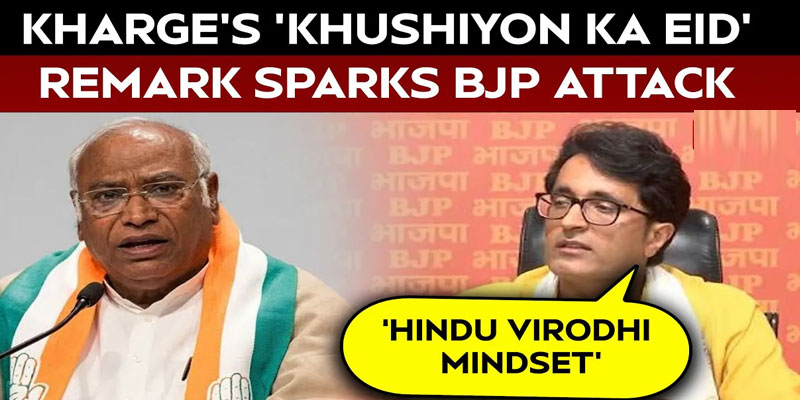
A festive greeting by Congress president Mallikarjun Kharge has triggered a fresh political confrontation after he described Diwali as “khushiyon ka ek Eid” (an Eid of happiness). The BJP strongly objected to the expression, accusing the Congress leadership of religious appeasement and challenging Kharge and Rahul Gandhi to describe Eid as a “Diwali of joy”. The Congress, meanwhile, defended the remark as an expression of communal harmony, arguing that it was intended to convey shared happiness rather than dilute the religious identity of Diwali.
What Exactly Did Kharge Say?
While extending Diwali greetings over the weekend, Kharge described the festival as a celebration of happiness across India and referred to it as “khushiyon ka ek Eid”. His apparent intention was to emphasise that festivals transcend religious boundaries and bring communities together. However, the use of the word Eid, commonly associated with Islamic festivals, immediately attracted political attention.
Congress leader Pawan Khera defended the expression, arguing that critics were being linguistically insensitive. He maintained that Eid also means a festival or celebration and that Kharge had used it metaphorically.
BJP’s Counterattack: An Open Challenge
The BJP accused Kharge of undermining the distinct cultural and religious identity of a major Hindu festival. Party leaders described the remark as anti-Sanatani and alleged that it reflected the Congress's politics of minority appeasement.
The BJP's challenge was particularly pointed: Kharge and Rahul Gandhi should demonstrate similar inclusiveness by describing Eid as a “Diwali of joy”.
BJP spokesperson Pradeep Bhandari and Union Minister Giriraj Singh questioned whether the Congress would use equivalent language for Islamic festivals. They portrayed the remark as an example of selective secularism and vote-bank politics.
Congress Defence: A Message of Unity
The Congress rejected the BJP's interpretation, insisting that Kharge's greeting was neither a religious comparison nor an attempt to change Diwali's identity.
· Pawan Khera argued that Eid means festival and defended its metaphorical use.
· Rashid Alvi dismissed the criticism, describing the expression as a familiar reference to happiness.
· The party maintained that the message celebrated India's pluralistic traditions and promoted communal harmony.
Political Context: Religion and Electoral Calculations
The controversy comes amid intensifying political competition ahead of the 2027 Uttar Pradesh Assembly elections. Religious identity, cultural symbolism and Hindu mobilisation remain important elements of electoral politics.
For the BJP, the remark provides an opportunity to question the Congress's approach to Hindu cultural identity. For Congress, defending Kharge's words reinforces its positioning around secularism and social inclusiveness.
When Festival Greetings Become Political Battlegrounds
The controversy demonstrates how a single expression can become a national political flashpoint in an increasingly polarised environment. While Kharge's words may have been intended to communicate shared happiness, the BJP has interpreted them as an attempt to blur religious distinctions. Equally, the Congress sees the criticism as an unnecessary controversy over an expression of goodwill. Ultimately, India's cultural strength lies in respecting the distinct identity of every religion while celebrating the spirit of coexistence. Political leaders must recognise that communal harmony requires sensitivity, consistency and mutual respect, not merely symbolic exchanges.
(With agency inputs)