A Landmark Oath in Bihar’s Political Theatre
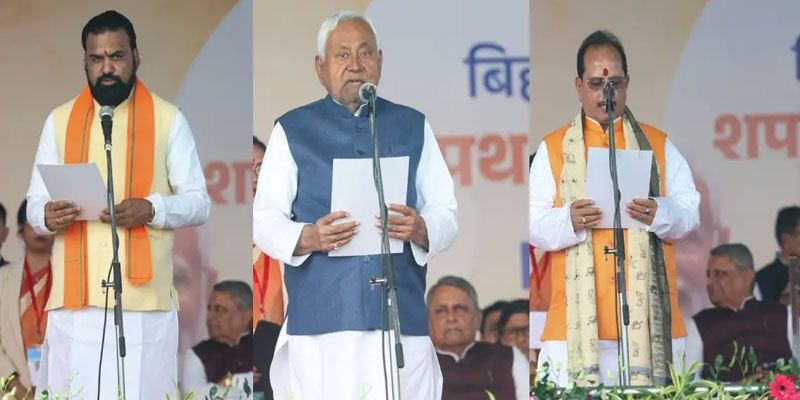
Nitish Kumar, chief of the Janata Dal (United), was sworn in for a historic tenth time as Chief Minister of Bihar at an elaborate ceremony in Patna’s iconic Gandhi Maidan. Administered by Governor Arif Mohammed Khan and attended by Prime Minister Narendra Modi along with top NDA leaders, the event symbolized both political continuity and the consolidation of the NDA’s sweeping 202-seat victory in the 2025 Assembly elections. The spectacle reaffirmed Nitish’s place as one of India’s most enduring regional leaders.
A Decade-Spanning Grip on Governance
Nitish Kumar’s return to the helm illustrates the intersection of electoral strategy, coalition flexibility, and developmental messaging that has long defined his leadership. The 2025 election was fiercely contested, with the JD(U) and its NDA partners battling a resurgent Mahagathbandhan. In this environment, Nitish positioned himself—once again—as the dependable face of governance, combining social welfare outreach with political agility. His tenth oath underscores not just longevity, but the capacity to reinvent alliances and narratives in response to shifting political landscapes.
Detailed Analysis: The Making of a Durable Leader
· Campaign Craft and Coalition Strength
The NDA’s landslide rested heavily on strategic messaging: development, women-focused schemes, and grassroots outreach. Nitish’s JD(U), working closely with the BJP, deployed a women-centric governance plank including the Mukhyamantri Mahila Rojgar Yojana, which played a decisive role in mobilizing female voters. The alliance’s invocation of PM Modi’s leadership further solidified its appeal across castes and regions.
· Ministerial Team: Consolidating Power
A total of 27 Ministers, including Chief Minister Nitish Kumar, took oath in the new Bihar government. The BJP contributed leaders such as Samrat Choudhary, Vijay Kumar Sinha, Dilip Jaiswal, Mangal Pandey, Nitin Nabin, and Ram Kripal Yadav, while JD(U) ministers included Leshi Singh, Shrowan Kumar, Bijendra Prasad Yadav, Zama Khan, and Ashok Chaudhary. The composition reflects careful coalition balancing, ensuring representation across key social groups and strengthening governance continuity.
· Nitish Kumar’s Political Flexibility
A defining trait of Nitish’s career has been strategic adaptability. His multiple shifts between alliances—sometimes with the BJP, sometimes with opposition blocs—have not diminished his electoral viability. Instead, they reveal a politician skilled in reading Bihar’s complex caste equations, especially among Extremely Backward Classes, and realigning political partnerships to maintain influence.
· Legacy and Governance Footprint
With nearly 19 cumulative years in office, Nitish stands as Bihar’s longest-serving Chief Minister in aggregate terms. His “Sushasan Babu” brand emerged after 2005, focusing on infrastructure upgrades, law and order improvements, and social sector reforms. While political instability has shadowed parts of his tenure, his governance model remains central to Bihar’s post-2000 transformation narrative.
· Symbolism of the 10th Oath
Gandhi Maidan, steeped in political history, offered an apt setting for this milestone. The presence of top national leaders reflected Bihar’s strategic prominence and Nitish’s continued relevance beyond state borders. For the NDA, his leadership offers stability, administrative experience, and coalition cohesion.
Stability, Strategy, and Expectations Ahead
Nitish Kumar’s tenth swearing-in is more than a ceremonial achievement—it reflects a political career shaped by resilience, negotiation, and governance-driven legitimacy. With a carefully composed 27-member cabinet and a strong NDA majority, his new term will be judged on Bihar’s economic acceleration, employment generation, and continued social welfare expansion. As Nitish enters yet another phase of leadership, he remains a case study in the dynamics of Indian coalition politics and the endurance of regional power centers.
(With agency inputs)