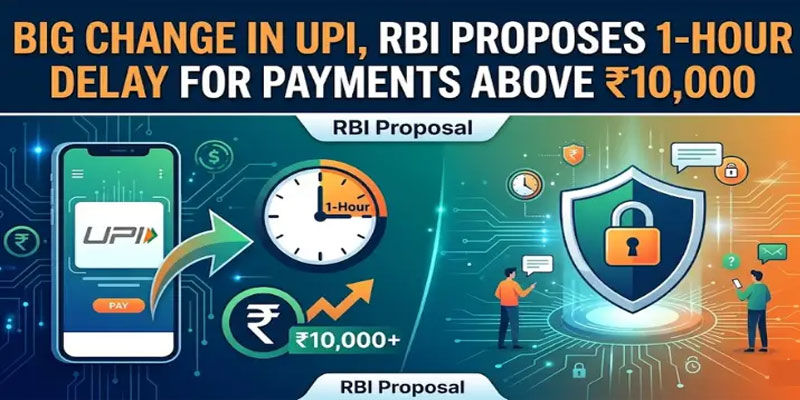
The Reserve Bank of India is considering a significant shift in India’s instant payments ecosystem by proposing a one-hour delay on certain high-value UPI and IMPS transactions. The move aims to curb the rising wave of digital fraud, particularly scams that trick users into authorising payments under pressure.
The Fraud Surge: A Growing Digital Threat
India’s digital payments boom—driven largely by Unified Payments Interface—has transformed financial transactions. However, this rapid growth has also created fertile ground for fraud.
Reported fraud cases have surged dramatically, rising from around 2.6 lakh in 2021 to nearly 28 lakhs in 2025. The value involved has jumped from ₹551 crore to over ₹22,000 crore. UPI-specific frauds also reflect this trend: incidents increased from 7.25 lakh cases (₹573 crore) in FY 2022–23 to 13.42 lakh cases (₹1,087 crore) in FY 2023–24.
While FY 2024–25 saw a slight dip to 12.64 lakh cases (₹981 crore), and FY 2025–26 data suggests moderation, fraud levels remain high. Notably, over 90% of fraud losses occur in transactions above ₹10,000—precisely the segment RBI is targeting.
What the RBI Proposal Entails
During this window:
· Users can review or cancel transactions.
· Banks can run enhanced fraud detection checks.
· Suspicious transactions may be flagged or blocked.
The delay would primarily apply to person-to-person transfers rather than routine merchant payments, preserving convenience for everyday use.
Complementary measures include user-controlled transaction limits, a universal “kill switch” to freeze digital payments, and stricter caps on accounts lacking robust KYC—often used as mule accounts in fraud schemes.
Understanding the Fraud Pattern: Post-2025 Trends
After peaking in FY 2023–24, UPI fraud appears to be stabilizing, though at elevated levels. Provisional data for FY 2025–26 shows around 10.64 lakh cases involving ₹805 crore, indicating a gradual decline but not a resolution.
A key characteristic is the dominance of “authorised push payment” scams—where users themselves initiate transfers after being deceived through phishing calls, fake investment schemes, or impersonation tactics. These are harder to reverse, making prevention critical.
Another concern is under-reporting. Industry estimates suggest a significant portion of fraud victims never file complaints, implying that actual figures may be substantially higher.
Benefits: A Safety Net for Users
The proposed delay targets the psychological tactics used by fraudsters, who often create urgency to prevent victims from thinking critically.
A one-hour buffer could:
· Allow users to verify suspicious requests.
· Enable intervention by banks and family members.
· Reduce large-value fraud losses significantly.
For vulnerable groups—such as elderly users or first-time digital adopters—this could enhance confidence in digital payments.
Challenges: Balancing Speed and Security
However, the proposal raises concerns about disrupting the core appeal of UPI—instant transactions. Delays could inconvenience users during emergencies or time-sensitive payments.
There is also the risk of fraudsters adapting by splitting transactions into smaller amounts or shifting to other payment channels. Additionally, banks will need to invest in advanced systems to manage delays and ensure seamless user experience.
A Calculated Trade-Off
The RBI’s proposal reflects a critical evolution in India’s digital payments journey—shifting from speed-first to safety-first. By introducing targeted friction in high-risk transactions, the central bank aims to address the most damaging segment of fraud without undermining the broader ecosystem.
If implemented with precision—focusing on high-value, high-risk transfers—the one-hour delay could act as an effective safeguard rather than a barrier. Ultimately, the success of this measure will depend on striking the right balance between convenience and security in an increasingly digital financial landscape.
(With agency inputs)