The Delhi Government has opened public consultation on its Draft Electric Vehicle (EV) Policy 2026–2030, inviting feedback from citizens and stakeholders to refine its roadmap for cleaner transport. Released on April 4, the draft underscores an urgent response to the capital’s persistent air pollution crisis and aims to accelerate the transition to sustainable mobility.
Building on Past Momentum: The Policy’s Vision
The new EV policy builds on earlier initiatives, seeking to significantly expand electric vehicle adoption across segments—two-wheelers, three-wheelers, passenger cars, and goods carriers. With over 10 million vehicles contributing to poor air quality, the policy positions electrification as a central solution to reducing emissions and dependence on fossil fuels.
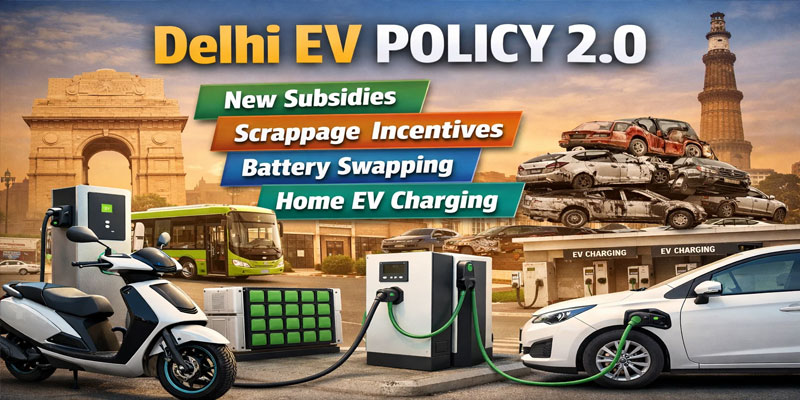
A key structural shift is the move toward scrappage-linked incentives. By encouraging the retirement of older, polluting BS-IV and internal combustion engine (ICE) vehicles, the policy aims to modernize Delhi’s fleet while improving environmental outcomes. At the same time, it focuses on creating a comprehensive ecosystem that includes charging infrastructure, battery recycling, and servicing networks.
Incentives Designed to Drive Adoption
The draft policy offers a range of financial incentives, though these are designed to taper over time as EV adoption grows and costs decline.
For electric two-wheelers priced up to ₹2.25 lakh, buyers can receive incentives starting at ₹10,000 per kWh (up to ₹30,000) in the first year, gradually reducing over three years. Electric auto-rickshaws are eligible for incentives beginning at ₹50,000, while electric trucks can receive up to ₹1 lakh initially.
Scrappage bonuses further sweeten the deal. Owners replacing older vehicles can receive ₹10,000 for two-wheelers, ₹25,000 for three-wheelers, up to ₹1 lakh for cars, and ₹50,000 for goods carriers. These benefits are time-bound, encouraging quicker transitions.
Additionally, all EVs will continue to enjoy 100% exemptions on road tax and registration fees until 2030, making them more financially attractive despite higher upfront costs. Retrofitting grants of up to ₹50,000 also support the conversion of existing ICE vehicles into electric ones.
Infrastructure and Ecosystem Development
A major pillar of the policy is the expansion of charging infrastructure through public-private partnerships. The government envisions a dense network of charging stations across the city, supported by innovations such as solar-powered charging to reduce grid pressure.
Equally important is the focus on supply chains. By promoting battery recycling and local servicing capabilities, the policy aims to create a circular economy around EVs, reducing environmental impact and ensuring long-term sustainability.
Economic and Environmental Benefits
The policy promises multiple benefits across sectors. For consumers, reduced fuel and maintenance costs can offset initial purchase prices, making EVs increasingly viable. Commercial operators, particularly auto-rickshaw drivers and fleet owners, stand to gain from significantly lower operating expenses.
Environmentally, widespread EV adoption could sharply reduce tailpipe emissions, addressing Delhi’s chronic air quality issues. Economically, the policy is expected to generate jobs in manufacturing, charging infrastructure, and recycling, while also lowering India’s oil import bill.
Challenges and Policy Implications
Despite its ambition, the policy faces several challenges. Increased electricity demand from EV charging could strain existing infrastructure, making renewable integration essential. The gradual reduction of subsidies also raises questions about sustained affordability, though falling battery prices may offset this concern.
The public consultation period—open until early May—offers an opportunity to address gaps, including equitable access and implementation hurdles.
A Decisive Step Toward a Cleaner Future
Delhi’s Draft EV Policy 2026 represents a comprehensive and forward-looking attempt to tackle pollution through systemic change. By combining incentives, infrastructure development, and environmental goals, it lays the groundwork for a cleaner, more sustainable urban transport system.
Its success, however, will depend on effective execution, stakeholder participation, and continuous adaptation. If implemented well, the policy could not only transform Delhi’s mobility landscape but also serve as a model for other cities striving toward a greener future.
(With agency inputs)