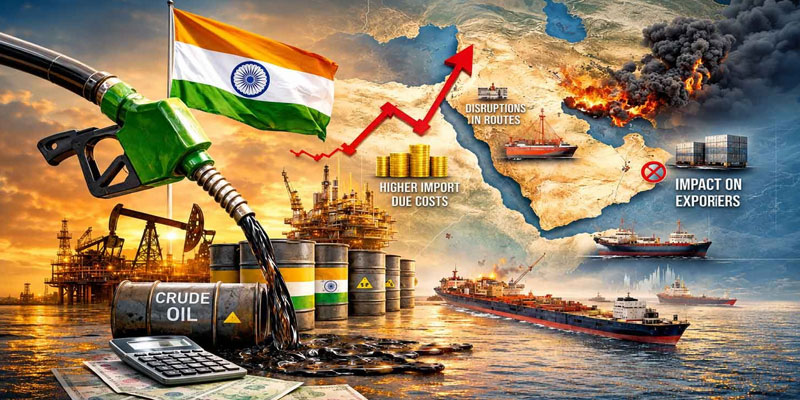
India’s crude oil import landscape witnessed a dramatic shift in March 2026 as supplies fell sharply amid the ongoing conflict involving Iran, while Russian volumes surged to record highs. According to official data, imports dropped 17% year-on-year to 18.9 million metric tonnes—the lowest level in five years—primarily due to disruptions in the Strait of Hormuz. At the same time, Russia captured an unprecedented 50% share of India’s crude basket, reshaping the country’s energy sourcing strategy.
Import Disruptions: West Asia Hit Hard
The conflict-driven instability in West Asia significantly impacted India’s traditional suppliers. Imports from countries such as Iraq, Saudi Arabia, and the UAE fell by 61%, reducing flows to just 1.18 million barrels per day. Given that nearly 45% of India’s oil imports typically pass through the Strait of Hormuz, the disruptions forced refiners to seek alternative routes and draw down reserves.
Despite the sharp March decline, India’s total crude imports for FY26 still grew marginally by 1% to 245.3 million tonnes. However, the cost burden increased significantly, with the average crude basket price rising to $113.49 per barrel compared to $72.47 a year earlier.
Russian Dominance: A Strategic Pivot
As West Asian supplies faltered, Russia stepped in to fill the gap. Imports of Russian crude nearly doubled month-on-month to 2.25 million barrels per day, accounting for half of India’s total imports for the first time. This surge was facilitated by discounted Urals crude and logistical adjustments, including US waivers for certain tanker shipments.
India now absorbs around 38% of Russia’s seaborne crude exports, second only to China. This marks a dramatic shift from pre-2022 levels, when Russian oil accounted for barely 1% of India’s imports. Additional supplies from countries like Angola also increased, though they remain a smaller share of the overall mix.
Economic Impact: Mixed Signals
The immediate economic impact has been complex. While lower import volumes helped reduce the March import bill by 5% year-on-year, rising global prices and a weaker rupee—hovering around 95 per US dollar—offset some of these gains. India’s trade deficit narrowed to $2.44 billion, offering temporary relief.
However, the volatility has triggered concerns about inflation and energy security. Indian refiners such as Reliance Industries and Nayara Energy have historically benefited from discounted Russian crude, saving $5–10 per barrel. With discounts narrowing, future cost advantages may diminish.
Strategic Shifts: Diversification with Risks
India’s rapid pivot toward Russian oil underscores a broader diversification strategy aimed at reducing dependence on any single region. Strategic petroleum reserves, currently covering about 64 days of consumption, have provided a buffer during the crisis.
However, increased reliance on Russia also brings geopolitical risks, particularly in the context of sanctions and shifting global alliances. With oil accounting for nearly 88% of India’s energy consumption needs, maintaining a balanced import portfolio remains critical.
Navigating Uncertainty in a Volatile Energy Market
India’s March import data highlights the fragility of global energy supply chains in times of geopolitical conflict. While the shift toward Russian crude has ensured continuity of supply, it also exposes the country to new strategic risks. Moving forward, India will need to balance short-term energy security with long-term diversification, including exploring alternative suppliers and accelerating its transition to renewable energy. In an increasingly volatile world, resilience and adaptability will define the future of India’s energy strategy.
(With agency inputs)