A Student Hub Turned into a Scene of Tragedy
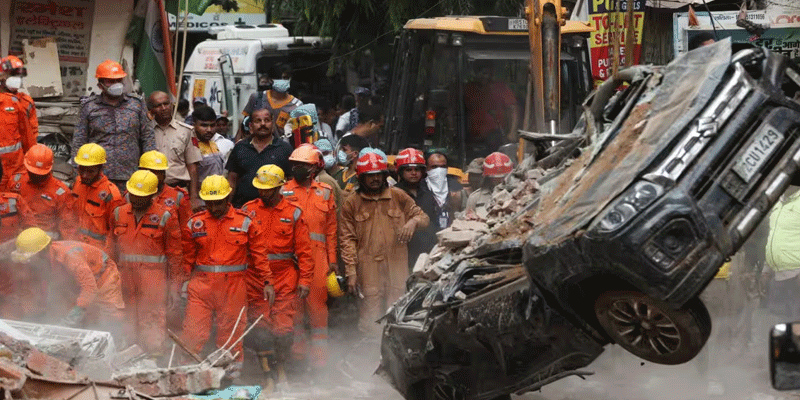
A five-storey boys’ paying guest (PG) hostel collapsed in Delhi’s Satya Niketan on Sunday afternoon, killing at least six people, most of them believed to be students, and leaving others feared trapped beneath the rubble. The tragedy has now triggered a magisterial inquiry, a police case against the building owner and a wider Municipal Corporation of Delhi (MCD) crackdown on unauthorised constructions.
A Decades-Old Building in a Crowded Student Hub
Satya Niketan, located near Delhi University’s South Campus, is one of the capital’s busiest student accommodation clusters, where PGs and hostels have expanded rapidly to meet demand. The collapsed property, locally known as “Hostel Daze”, was reportedly 30–50 years old and stood on a plot of only about 55 square yards.
The structure was originally sanctioned for ground plus one floor (G+1). However, it had allegedly been extended to a basement and four additional floors, creating a five-storey building that accommodated dozens of students in a densely packed residential setting.
Rescue Operations Reveal the Scale of Disaster
Rescue teams from the National Disaster Response Force, Delhi Fire Service, Delhi Police and Delhi Disaster Management Authority worked through the night, cutting through heavy debris in the search for survivors. By Monday morning, six bodies had reportedly been recovered while 11 people had been rescued. Some victims pulled from the debris overnight were declared dead, raising the toll from the initial figure reported on Sunday.
Local residents had earlier feared that as many as 40 people could be trapped, highlighting the uncertainty surrounding the number of occupants inside the building when it collapsed.
FIR, Probe and Political Accountability
Delhi Chief Minister Rekha Gupta ordered a magisterial inquiry and directed authorities to register an FIR against the building owner. Police subsequently invoked Sections 105, 290 and 125(a) of the Bharatiya Nyaya Sanhita, relating to culpable homicide, negligence in construction or repair, and rash acts endangering human life.
Prime Minister Narendra Modi expressed condolences, while Delhi University conveyed grief over the loss of students. Student organisations have demanded accountability and a comprehensive safety audit of PG accommodations across Delhi.
Illegal Floors Raise Serious Regulatory Questions
Preliminary findings indicate several alleged violations, including the absence of a sanctioned plan for the existing structure, unauthorised basement construction and additional floors beyond the permitted G+1 configuration.
More troublingly, an MCD report reportedly found no record of the property being booked or sealed and no complaints concerning construction work. This has raised serious questions about inspection mechanisms and enforcement in an area where unauthorised construction is widespread.
The MCD has now ordered immediate sealing of illegal structures exceeding four floors and warned that officials found responsible for enforcement failures could face dismissal. An adjoining property deemed dangerous has also been ordered to be demolished.
From One Collapse to a Citywide Safety Reckoning
The Satya Niketan tragedy is more than a building collapse; it exposes vulnerabilities within Delhi’s rapidly expanding student-housing ecosystem. Ageing buildings, unauthorised vertical extensions, overcrowding and inadequate inspections can turn ordinary accommodation into a deadly hazard.
The real measure of accountability will be whether the current crackdown becomes a sustained reform. Mandatory structural assessments, occupancy and load checks, periodic fitness certificates for PGs and strict penalties for illegal construction could help prevent another tragedy. For Delhi’s students, safety cannot remain an afterthought—it must become the foundation of urban governance.
(With agency inputs)