India’s Air Power Leaps into the Future
As the Indian Air Force (IAF) accelerates its technological transformation, indigenous innovation is fast becoming its cornerstone. From stealth platforms to advanced avionics, the IAF’s modernization blueprint is being steadily supported by the Defence Research and Development Organisation (DRDO), which continues to bridge crucial capability gaps.
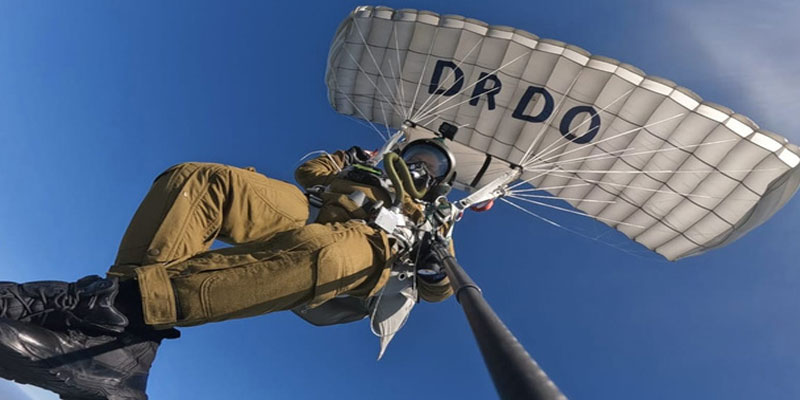
In yet another stride toward self-reliance, the IAF has successfully tested DRDO’s Military Combat Parachute System (MCPS) from an altitude of 32,000 feet, setting a new benchmark in India’s defence indigenisation journey. The test marks not just a technological triumph but a symbolic leap toward operational autonomy.
A Breakthrough at 32,000 Feet
According to the Ministry of Defence, the MCPS is now the only operational parachute system in the Indian Armed Forces capable of functioning beyond 25,000 feet. The successful combat freefall jump, executed by IAF test paratroopers, validated the system’s efficiency, safety, and advanced design features under real combat-like conditions.
Developed by DRDO’s Aerial Delivery Research and Development Establishment (ADRDE) in Agra and the Defence Bioengineering and Electromedical Laboratory (DEBEL) in Bengaluru, the MCPS represents a fusion of aeronautical precision and human-centred engineering.
Cutting-Edge Features: Designed for Precision and Safety
The MCPS incorporates a range of tactical enhancements tailored for high-altitude operations. With a lower rate of descent and improved steering control, it allows paratroopers to execute safer and more accurate landings even in challenging terrains.
What sets the system apart is its compatibility with India’s own satellite navigation network — Navigation with Indian Constellation (NavIC). This integration ensures independent operational capability, making the system immune to potential disruptions or denial of service by foreign entities — a vital safeguard in wartime scenarios.
Moreover, the MCPS design facilitates pre-programmed altitude deployment and precise navigation, enabling commandos to glide undetected toward mission zones. The indigenous system also promises lower maintenance turnaround time compared to imported alternatives, significantly boosting readiness during critical missions.
Indigenous Edge: Reducing Dependence, Boosting Readiness
Beyond its technical prowess, the MCPS test carries strategic weight. India’s reliance on imported aerial delivery systems has long posed logistical and cost challenges. The successful demonstration now opens the door to domestically produced parachute systems, enhancing the military’s self-sufficiency and rapid deployability.
Officials noted that the indigenous system not only lowers maintenance costs but also ensures availability during emergencies, insulating India’s defence operations from foreign supply disruptions — a decisive advantage in today’s volatile global security landscape.
Leadership Applauds a Milestone
Defence Minister Rajnath Singh lauded DRDO, the IAF, and India’s defence industry for achieving what he described as a “significant milestone in indigenous defence capability.” He emphasised that the MCPS success will reduce dependence on external sources and strengthen India’s preparedness for future conflicts.
Dr. Samir V. Kamat, Secretary of Defence R&D and DRDO Chairman, praised the team for this accomplishment, calling it a “major step toward self-reliance in aerial delivery systems.”
A Descent that Elevates India’s Defence Future
The successful test of the Military Combat Parachute System underscores India’s commitment to the ‘Atmanirbhar Bharat’ vision — self-reliance through innovation. As the IAF modernizes its fleet and capabilities, DRDO’s indigenous breakthroughs like the MCPS ensure that technology, strategy, and sovereignty evolve hand in hand.
This achievement at 32,000 feet is not just a test of altitude but of altitude — a soaring testament to India’s resolve to rise on its own wings.
(With agency inputs)