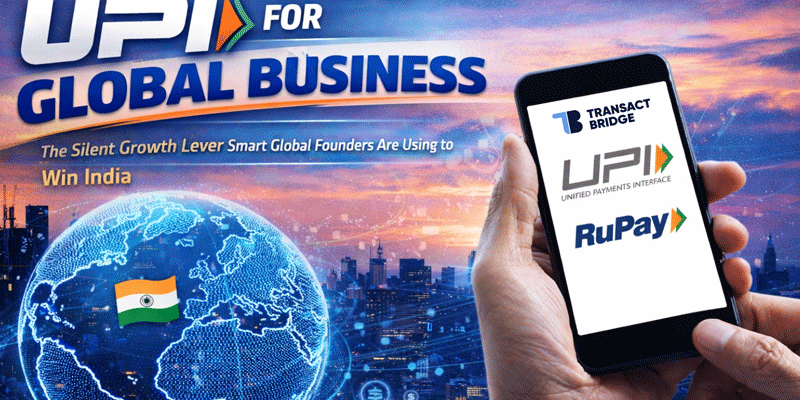
India’s Unified Payments Interface (UPI) is entering a new phase of global expansion, moving beyond simply being available in other countries to becoming directly interoperable with their domestic payment systems. At the Global Fintech Fest 2026 in Mumbai, Prime Minister Narendra Modi called for this next step, arguing that deeper connectivity could make cross-border payments as simple as domestic transfers.
From Digital Experiment to Global Payments Powerhouse
Launched in 2016, UPI has transformed India’s payments landscape by enabling instant, interoperable bank-to-bank transactions through mobile devices. Ten years later, its scale is unprecedented. In August 2026, UPI processed a record 24.51 billion transactions worth ₹29.82 lakh crore, with transaction volume rising about 22% year-on-year.
The platform now operates in 11 countries, demonstrating that India’s digital public infrastructure has moved beyond domestic adoption to international relevance.
PM Modi’s Next Phase: Connect Payment Rails
Modi’s message at the fintech summit was clear: international availability is only the beginning. The next objective is to connect UPI directly with the payment systems of partner countries, following the model of India’s linkage with Singapore’s PayNow.
Such interoperability could significantly simplify remittances for Indians living abroad, reduce transaction friction and support businesses engaged in cross-border trade. Modi particularly emphasised countries with large Indian communities, strong trading relationships with India or an interest in digital cooperation.
The strategic significance extends beyond convenience. Interconnected payment rails could strengthen India’s influence in setting global digital-payment standards while establishing UPI as an important component of international financial infrastructure.
7.8% Growth Gives the World Fresh Hope
The UPI push came alongside a broader economic message from the Prime Minister. “PM Modi says India’s 7.8 GDP growth gives world fresh hope, hints major policy reforms, next phase of UPI”—a message linking India’s fintech success with its wider economic trajectory.
Speaking against a backdrop of geopolitical tensions, trade uncertainty and pressure on global supply chains, Modi said India’s 7.8% growth gives the world “fresh hope”. He also signalled that the government’s “reform express” would gather further momentum.
Beyond Payments: AI, Security and Trust
The next fintech phase will not be confined to conventional transactions. The government is looking toward agentic AI, tokenisation and quantum technologies, while encouraging fintech to expand into credit, insurance, savings, investments and pensions.
At the same time, Modi outlined four priorities: stronger cybersecurity, ethical data-protection standards, deeper regulator-industry innovation and a fintech consumer-protection index.
From UPI Success to Global Digital Leadership
UPI’s next challenge is therefore larger than expanding its geographical footprint. India must build trusted, secure and mutually compatible payment connections that deliver tangible benefits to citizens and businesses across borders.
If the first decade established UPI as India’s digital-payment revolution, the next could determine whether it becomes a global digital bridge—linking economies, lowering the cost of cross-border transactions and giving India a stronger voice in shaping the financial architecture of the future.
(With agency inputs)