The debate over Vande Mataram has widened after actor-politician Kangana Ranaut reacted sharply to veteran actor Sharmila Tagore’s reservations about portions of the National Song. Tagore argued that people who believe in one God could find the later stanzas difficult because they contain references to Hindu deities, while suggesting that the first two stanzas are more appropriate for a religiously diverse India. Ranaut defended the song’s artistic and historical character, arguing that poetic references to Shakti can symbolise strength and empowerment rather than prescribe religious worship.
A Freedom Song at the Heart of Debate
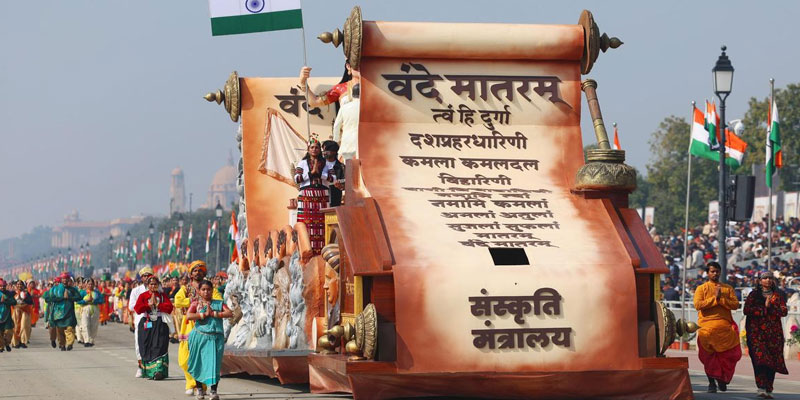
Written by Bankim Chandra Chattopadhyay in the late 19th century, Vande Mataram became an important cultural symbol of India’s freedom struggle. It was first sung at the 1896 session of the Indian National Congress and subsequently became closely associated with anti-colonial mobilisation.
The controversy has historical roots. In 1937, the Congress decided that only the first two stanzas should ordinarily be used at national gatherings because the subsequent verses contain explicit religious imagery. After Independence, the Constituent Assembly recognised Vande Mataram as the National Song on January 24, 1950, while Jana Gana Mana was adopted as the National Anthem.
What Exactly Has the Government Prescribed?
The latest controversy stems from a formal 2026 protocol issued by the Union Ministry of Home Affairs covering the singing or playing of the National Song at specified official and ceremonial occasions. The MHA website lists the “Orders relating to singing or playing of the National Song and the National Anthem of India” among its July 2026 documents.
The important provisions include:
· Full six-stanza version: The protocol provides for the complete version of Vande Mataram, rather than limiting ceremonial performance to the traditionally used first two stanzas.
· Three-minute-ten-second rendition: The prescribed complete rendition is approximately 3 minutes and 10 seconds.
· National Song before National Anthem: Where both are performed at the same occasion, Vande Mataram is to precede Jana Gana Mana.
· Standing at attention: Those present are required to maintain the prescribed ceremonial decorum during the National Song.
· Official occasions: The protocol covers specified government and ceremonial functions, including flag-unfurling ceremonies, the President’s arrival at certain functions, Governors’ addresses, cultural programmes and other government events.
· Schools and group singing: The directions also provide for group singing in school assemblies and specified institutional settings.
The purpose is essentially standardisation of ceremonial practice, rather than transforming the National Song into a religious observance.
Artistic Expression Versus Constitutional Inclusion
This distinction is central to the present dispute. Ranaut views the imagery through the lens of poetry and symbolism, while Tagore’s concern focuses on whether every citizen can comfortably identify with a national symbol containing explicitly religious references.
Both positions have historical legitimacy. Vande Mataram carries immense nationalist significance, but its contested verses also explain why earlier generations adopted a compromise centred on the first two stanzas.
The Supreme Court has also distinguished ceremonial instructions from a compulsory religious obligation, noting that the challenge before it was based on an apprehension of discrimination. The distinction matters in a constitutional democracy where respect for national symbols must coexist with freedom of conscience.
National Symbols Must Unite, Not Divide
The latest Vande Mataram controversy is ultimately larger than the exchange between two prominent cultural voices. It raises the question of how India balances historical heritage, artistic expression, national symbolism and religious diversity.
The government’s protocol seeks uniformity in official ceremonies, but its broader success will depend on ensuring that patriotism does not become synonymous with religious conformity. Vande Mataram can retain its extraordinary place in India’s freedom story while allowing citizens space for interpretation and conscience. A national symbol is strongest not when disagreement is silenced, but when its unifying meaning remains larger than the differences surrounding it.
(With agency inputs)