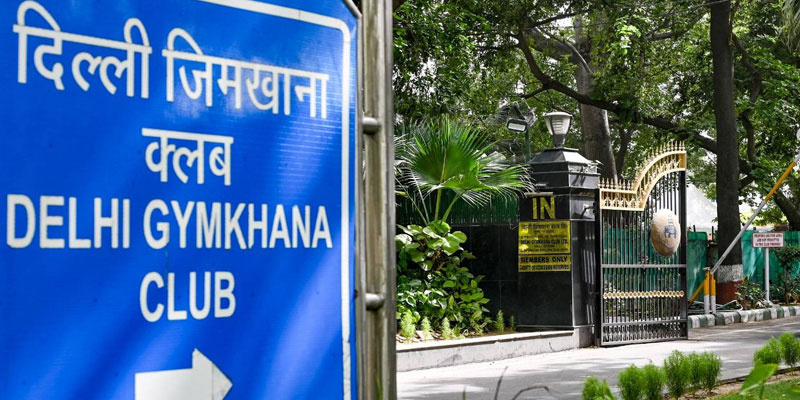
The historic Delhi Gymkhana Club, one of the capital’s most prestigious institutions, has been thrust into a major legal and administrative controversy after the Centre directed it to vacate its sprawling 27.3-acre premises by June 5. The development comes amid a parallel dispute over sharply revised ground-rent demands, which have risen to more than ₹47 crore annually. While the government has justified its action on grounds of national security and strategic land use, the club has challenged both the rent escalation and the eviction order, setting the stage for a closely watched legal battle.
A Historic Institution at the Centre of a Dispute
Founded over a century ago, the Delhi Gymkhana Club occupies a prime location in Lutyens’ Delhi, one of the most strategically important and politically significant zones in the country.
The controversy began after the Land and Development Office (L&DO), functioning under the Ministry of Housing and Urban Affairs, issued an order directing the club to vacate its premises. According to the government, the land is required for defence and security-related infrastructure, particularly given its proximity to the Prime Minister’s residence and other sensitive installations.
The club, however, maintains that the order is unjustified and has supported legal efforts challenging the directive before the Delhi High Court.
The Controversy Over Ground Rent
A major aspect of the dispute revolves around the dramatic increase in the club’s ground-rent obligations.
For decades, the club operated under a lease arrangement that involved an annual rent of only a few hundred rupees, reflecting terms established during the colonial era. In 2023, authorities revised the annual rent to more than ₹4 crore. The latest notices issued in 2026 have raised the figure further to over ₹47.59 crore annually.
The club argues that the increase is excessive, disproportionate, and financially punitive. Its representatives contend that such a steep escalation effectively undermines the viability of the institution and amounts to an arbitrary revision of long-standing lease arrangements.
The government, on the other hand, views the revision as a necessary correction to reflect the extraordinary value of the land occupied by the club in one of Delhi’s most premium locations.
Security Concerns and the Eviction Order
The Centre has framed the eviction issue primarily through the lens of national security and public interest.
Officials have argued that the land is needed to strengthen strategic infrastructure and enhance security arrangements in a highly sensitive area of the national capital. Given the location’s proximity to key government establishments, the administration maintains that retaining the land for broader security purposes serves a larger public objective.
This position reflects a broader policy shift toward reassessing legacy land allocations that were granted under vastly different historical circumstances.
Legal Challenge and Wider Implications
The Gymkhana Club has responded by contesting both the rent demands and the eviction order before the Delhi High Court.
Beyond the legal questions, the case raises broader issues concerning heritage institutions, lease rights, public land management, and the balance between historical privileges and contemporary public priorities. The club also emphasizes its role in supporting employees, sporting activities, and social engagement in the capital.
Heritage, Public Interest and the Rule of Law
The Delhi Gymkhana dispute represents more than a disagreement over rent or property. It has evolved into a test case on how India reconciles colonial-era land arrangements with present-day governance, security needs, and public accountability. As the courts examine the competing claims of historical rights and national priorities, the outcome could shape future policy toward similar institutions occupying prime public land. Ultimately, the case underscores the challenge of balancing heritage, legality, and public interest in a rapidly changing urban and strategic landscape.
(With agency inputs)