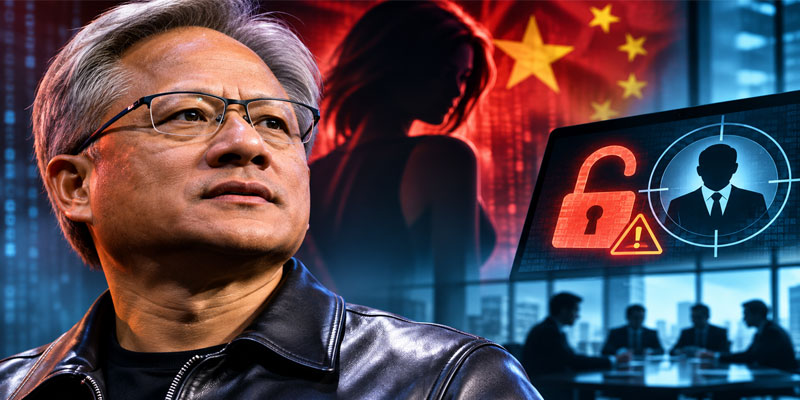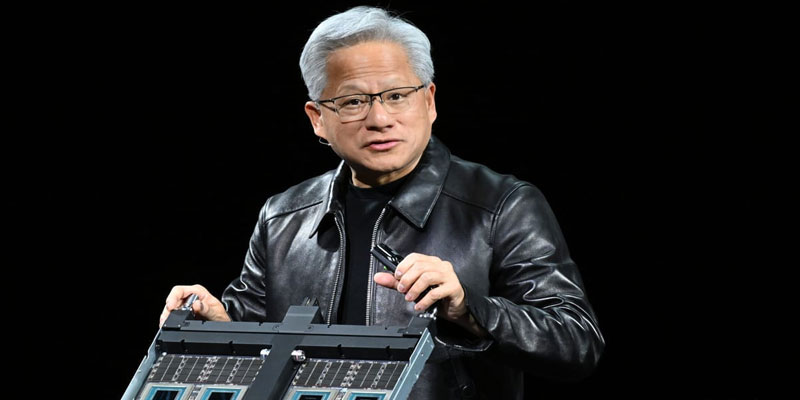
Nvidia is facing deepening scrutiny over China chip ties and an alleged affair involving its chief executive, Jensen Huang, raising serious questions about corporate governance, export-control compliance and national security. What began as a personal controversy has rapidly escalated into a potentially damaging crisis involving allegations of intelligence links, restricted semiconductor shipments, a federal counterintelligence inquiry and mounting investor concerns.
How a Personal Controversy Became a Corporate Crisis
Jensen Huang, co-founder and CEO of Nvidia, has acknowledged an affair with Alice Huang, a Singapore-based business executive formerly associated with data-centre company Megaspeed. However, the controversy intensified after US officials reportedly assessed that Alice Huang might have been gathering information for Beijing. China has rejected the espionage allegations, describing them as unsubstantiated.
An investigation published by The Information alleged that the relationship helped facilitate at least $7.5 billion worth of Nvidia chip shipments to Chinese companies. According to the report, a network involving Shanghai Century Litong and Megaspeed allegedly moved approximately 240,000 advanced H100, H200 and A100 chips into China, including products subject to US export restrictions. Reuters said it could not independently verify these allegations.
Board Investigation and FBI Counterintelligence Probe
The controversy prompted Nvidia's board to initiate an internal investigation. Its independent directors appointed Joon Kim, former acting US attorney for the Southern District of New York and a partner at Wachtell, Lipton, Rosen & Katz, to lead the inquiry.
Separately, US President Donald Trump confirmed that the FBI was investigating whether Huang had been targeted through a foreign intelligence operation. Trump said Huang had told him he had no knowledge of Alice Huang being a spy. Huang has pledged full cooperation.
Market Turmoil and Political Pressure
Nvidia's shares suffered a sharp decline, wiping out approximately $430 billion in market capitalisation over two trading sessions, with reported losses potentially approaching $470 billion as trading continued.
Republican Senator Kevin Cramer has called for Huang's resignation, while Democratic leaders, including Senator Mark Warner and Representative Hakeem Jeffries, have sought greater clarity about the national-security implications. Trump, meanwhile, has publicly expressed confidence in Huang.
Six Major Issues Facing Nvidia
· Leadership credibility: The investigation must establish Huang's knowledge, judgment and disclosure obligations.
· Export-control violations: Proven diversion of restricted chips could invite regulatory penalties or criminal investigations.
· National security: Authorities must determine whether sensitive corporate or technological information was compromised.
· China business: Further restrictions could undermine Nvidia's access to the Chinese semiconductor market.
· US-China relations: The controversy adds another complication to an already tense technology rivalry.
· Investor confidence: Prolonged uncertainty could affect Nvidia's valuation, customer relationships and the wider AI ecosystem.
Allegations Versus Established Facts
Importantly, the alleged $7.5 billion shipments, Alice Huang's suspected intelligence connections and Jensen Huang's possible knowledge remain unproven. Nvidia maintains that it has found no evidence of compromised proprietary information or national security.
The Verdict: Evidence Will Determine Nvidia's Future
The unfolding controversy represents a critical test of Nvidia's leadership, compliance framework and global credibility. At a time when advanced semiconductors underpin economic competitiveness and national security, even allegations of improper technology transfers carry enormous consequences. Ultimately, the investigation must establish whether personal relationships intersected with corporate distribution channels and restricted chip movements. Until credible evidence emerges, allegations must not be treated as established wrongdoing. For Nvidia, however, restoring investor confidence and demonstrating that its governance and export-control safeguards remain uncompromised will be essential to protecting its position at the centre of the global AI revolution.
(With agency inputs)