

India has moved with notable agility as rising tensions around Iran threaten to destabilize West Asia, with S. Jaishankar spearheading a series of high-level diplomatic engagements. His outreach to key global and regional partners signals New Delhi’s intent to remain actively involved without being drawn into rigid geopolitical alignments. As the crisis deepens, India’s priority is clear: safeguard energy flows, protect its vast diaspora, and preserve regional stability through dialogue rather than confrontation.
Strategic Signalling Through Multilateral Engagement
Jaishankar’s recent consultations reveal a carefully calibrated diplomatic approach. Conversations with Penny Wong emphasized shared concerns over stability, humanitarian challenges, and the security of maritime trade routes. This alignment reflects India’s growing coordination with like-minded nations that are wary of an escalating Gulf conflict.
Similarly, discussions with Vivian Balakrishnan highlighted the broader economic ripple effects of the crisis. For trade-dependent economies across Asia, disruptions in West Asia pose immediate risks to supply chains, shipping lanes, and financial markets. India’s engagement here underscores its role as a voice for economic stability in the Indo-Pacific.
Deepening Gulf Partnerships and Diaspora Priorities
India’s diplomacy has also focused sharply on its core partners in the Gulf. Engagements with Kuwait and high-level interactions in Abu Dhabi with Sheikh Mohamed bin Zayed Al Nahyan underline the depth of India’s economic and human ties to the region. The UAE, in particular, has emerged as a central pillar in India’s West Asia strategy, acting as a bridge for trade, energy, and investment flows.
The ambitious UAE–India roadmap to double bilateral trade to $200 billion by 2032 adds strategic urgency to these engagements. By conveying greetings from Narendra Modi and acknowledging support for the Indian diaspora, Jaishankar reinforces a narrative of mutual dependence. This not only strengthens bilateral trust but also positions India as a credible interlocutor in times of regional uncertainty.
A Carefully Balanced Geopolitical Posture
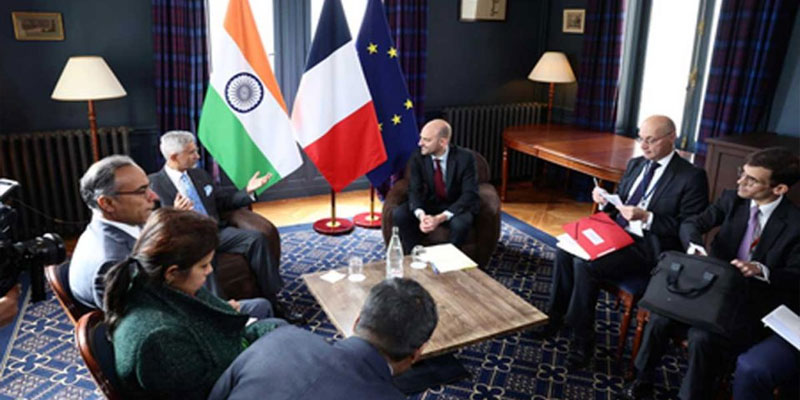
India’s approach to the Iran crisis is defined by strategic balance. On one hand, it continues security coordination with Israel and Western partners, evident in Jaishankar’s dialogue with Gideon Sa’ar on issues ranging from Iran to the Strait of Hormuz and Lebanon. On the other, New Delhi avoids overt alignment against Tehran, maintaining open channels with diverse actors across the Gulf.
This hedged strategy reflects India’s core interests. The country depends heavily on hydrocarbon imports from the region and is home to nearly nine million citizens working across Gulf economies. Any disruption—whether in oil supplies or shipping routes—would have immediate economic consequences. By advocating ceasefires and dialogue, India positions itself as a stabilizing force rather than a partisan player.
Diplomacy as Risk Management and Strategic Leverage
India’s intensified West Asia diplomacy is less about projecting power and more about managing risk in an increasingly volatile environment. Under Jaishankar’s stewardship, New Delhi has embraced a pragmatic strategy that combines restraint with active engagement. By balancing relationships, leveraging economic ties, and prioritizing diaspora welfare, India is carving out a role as a credible, steady actor in a fractured region.
In a crisis defined by shifting alliances and uncertain outcomes, India’s approach demonstrates that influence need not stem from confrontation. Instead, it can emerge from consistency, credibility, and the ability to engage all sides—turning cautious diplomacy into a form of strategic leverage.
(With agency inputs)