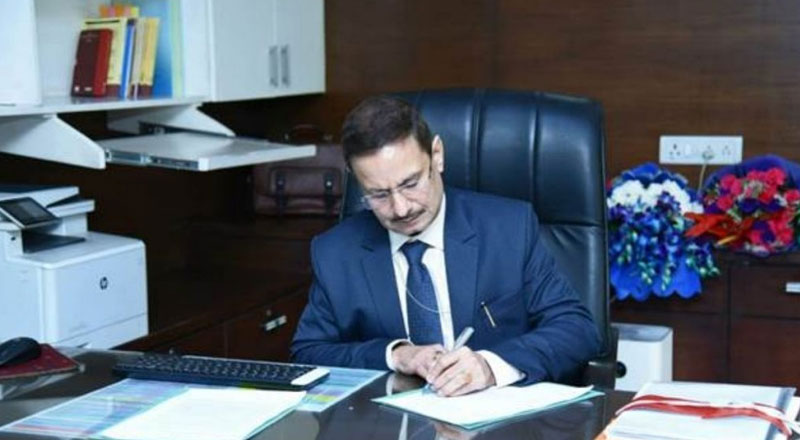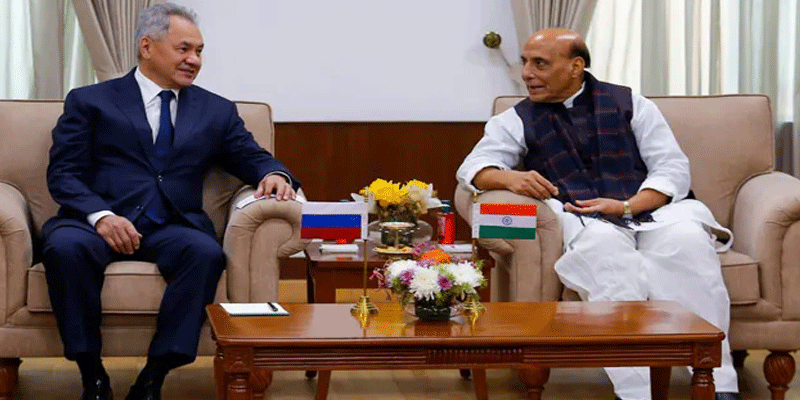
Army Chief General Dhiraj Seth is in Russia for a three-day official visit from September 16 to 18, with discussions expected to reinforce military cooperation and address the future of India’s Russian-origin defence fleet. The visit, the first by an Indian Army chief to Russia since General Bipin Rawat’s 2018 trip, comes as New Delhi balances longstanding defence ties with Moscow against its push for diversification and indigenous production.
Moscow Visit Comes at A Strategic Moment
General Seth’s itinerary includes talks with Colonel General Andrei Mordvichev, Commander-in-Chief of the Russian Land Forces, meetings with senior Russian defence officials and a visit to the National Defence Control Centre. He will also travel to St Petersburg to visit the Mikhailovskaya Military Artillery Academy. The official agenda focuses on military cooperation, training, contemporary military developments and defence cooperation.
However, the visit also assumes significance because a substantial portion of India’s existing land-warfare inventory originated in Russia or the former Soviet Union. Ensuring availability of spares, maintenance support and upgrades remains important for keeping these platforms operational.
Russian-Origin Platforms Remain Operationally Important
India continues to operate major Russian-origin systems across its armoured and mechanised formations and air-defence elements. These include T-72 and T-90 tanks and BMP-series infantry fighting vehicles, alongside several other Russian-designed systems.
With battlefield technology evolving rapidly, modernisation is increasingly about integrating new sensors, weapons, communications and protection systems into existing fleets rather than simply replacing entire inventories.
Reports indicate that discussions could cover:
· Spare parts and upgrades: Maintaining reliable supplies for Russian-origin tanks, infantry vehicles and other equipment.
· Pantsir-S1M: Russia has reportedly offered its upgraded short-range air-defence system for consideration against India’s Carrier Air Defence Tracked requirement.
· BMP-3: Moscow is promoting the infantry fighting vehicle as a possible successor or complement to India’s BMP-2 fleet.
· Future Ready Combat Vehicle: Russian proposals could also feature in discussions surrounding India’s future main battle tank programme, although any acquisition or joint-development decision would depend on formal evaluation and procurement processes.
Balancing Russian Ties with Atmanirbhar Defence
The discussions come as India expands domestic defence production and seeks a broader supplier base involving countries such as France, the United States and Israel. Indigenous programmes, including the Zorawar light tank and other Army modernisation initiatives, are intended to progressively reduce dependence on imported systems.
At the same time, replacing large Russian-origin fleets quickly would be operationally and financially complex. Consequently, sustaining existing capabilities while gradually increasing Indian content remains an important transition challenge. General Seth has himself stressed technology absorption, indigenous capability development and preparation for the changing character of warfare.
From Legacy Dependence to Future Readiness
General Seth’s Moscow visit illustrates the practical dimensions of India-Russia defence ties. It is not simply about potential new purchases; sustaining equipment already deployed with the Army is equally significant.
The immediate discussions on spares, upgrades, air defence and future combat vehicles will therefore need to fit within a larger transformation of India’s land forces. The direction is increasingly towards combining established partnerships with domestic design, production and technology absorption. Russia remains relevant to that transition, but the longer-term objective is a more resilient Indian defence ecosystem capable of meeting future requirements with greater indigenous capacity.
(With agency inputs)