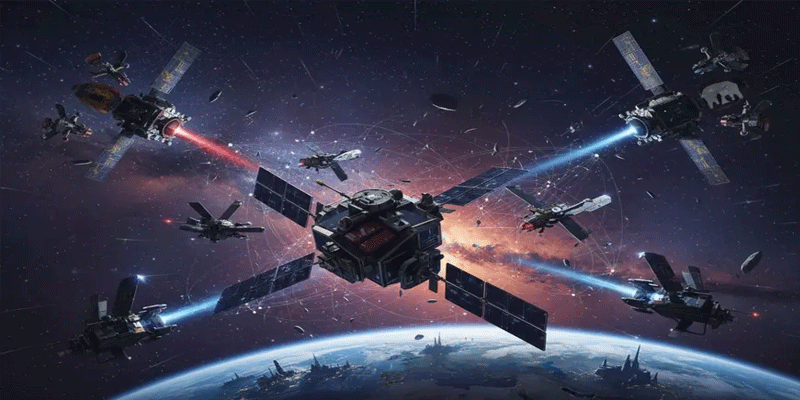
In a first, the US Space Force has publicly confirmed that weapons are already deployed in Earth orbit, marking a major shift from strategic ambiguity to open acknowledgement of American offensive and defensive space capabilities. Air Force Secretary Troy Meink made the disclosure on September 14 at the Air & Space Forces Association’s Air, Space & Cyber Conference in Maryland, saying the US now has “on-orbit space control weapons” capable of defending American forces against hostile actions.
From Space Exploration to A Contested Battlefield
Space has been militarised since the Cold War, when the United States and Soviet Union began developing satellites for communications, reconnaissance and military navigation. The 1967 Outer Space Treaty prohibits placing nuclear weapons and other weapons of mass destruction in orbit, but does not comprehensively ban conventional weapons or anti-satellite capabilities.
As military dependence on satellites has grown, so has competition over the ability to disrupt, disable or destroy them. China and Russia have developed counterspace capabilities, while Washington established the US Space Force in 2019 as a separate military service dedicated to protecting American interests in the space domain.
What Exactly Has America Deployed?
Meink did not identify the weapons, their number, location or precise capabilities. He described them as “on-orbit space control weapons” capable of defending the joint force against hostile adversary action. A Space Force explanation indicated that space control can involve both kinetic and non-kinetic means to affect an adversary’s space capabilities.
That distinction is important. The disclosure does not necessarily mean conventional missiles are flying around orbit waiting to strike satellites. Space-control systems could encompass technologies designed to interfere with, disable or otherwise affect hostile spacecraft. Some analysts have pointed to possibilities including electronic or other non-kinetic systems, although Washington has not publicly confirmed the nature of the weapons.
Why The US Made the Disclosure Now
The timing appears closely connected to deterrence. Meink indicated that the wording of the announcement was deliberate and “very well thought out”, while stressing the importance of being able to defend US forces as adversaries develop their own capabilities.
The principal strategic audience is widely understood to include China and Russia, both of which Washington regards as increasingly capable competitors in space. The disclosure therefore sends a message that the US does not intend to remain dependent on defensive measures alone if its satellites or forces come under attack.
The Risk of a New Space Arms Race
The announcement could nevertheless intensify competition. Satellites underpin GPS, military communications, intelligence, missile warning and increasingly civilian economic activity. Any conflict involving them could therefore have consequences far beyond orbit.
A kinetic attack could also generate orbital debris capable of damaging unrelated spacecraft, creating risks for commercial operators and other countries. China has already warned against actions that could trigger a new arms race in space.
Space Is No Longer Just a Strategic High Ground
America’s disclosure represents more than a new weapons announcement; it confirms that space is becoming an operational battlespace in its own right. The Outer Space Treaty remains an important legal framework, but technological advances are exposing gaps between what international law explicitly prohibits and what modern military systems can actually do.
The challenge now is to strengthen deterrence without normalising unrestricted warfare in orbit. As nations protect increasingly valuable space assets, the next phase of global security may depend on whether major powers establish clearer rules before competition turns the final frontier into another battlefield.
(With agency inputs)