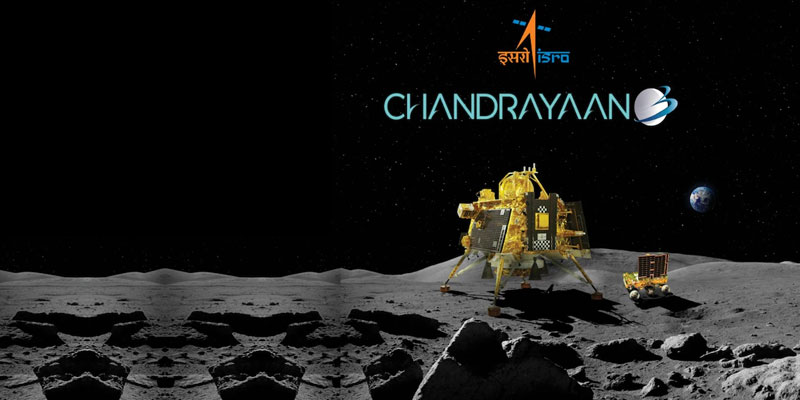
What seemed like a small experimental maneuver during India’s historic Chandrayaan-3 mission has now emerged as a major scientific breakthrough. After successfully landing near the Moon’s south pole in August 2023, the Vikram lander still had some unused fuel left in its tanks. Instead of letting it go unused, the Indian Space Research Organisation decided to attempt a brief “hop” on the lunar surface. The lander lifted roughly 40 centimetres above the ground before gently settling a short distance away. Nearly two years later, scientists say that tiny jump has uncovered crucial new information about the Moon’s hidden soil structure.
A Small Experiment with Big Scientific Value
The hop experiment was initially viewed as a low-risk engineering test. By briefly reigniting Vikram’s engines on the Moon’s surface, ISRO wanted to observe how lunar soil — known as regolith — reacted to engine exhaust, vibration, and pressure.
However, the maneuver produced an unexpected scientific opportunity. The force from the thrusters swept away the Moon’s loose top layer of dust, exposing denser material underneath. Scientists discovered that the upper lunar surface near the south pole is not uniform but consists of distinct layers with very different physical properties.
Researchers now describe the structure as “cake-like,” with a soft, fluffy upper coating sitting above a compact and cohesive lower layer. The experiment effectively peeled back the Moon’s surface like a thin crust, allowing scientists to study what lies just beneath.
New Insights into Lunar Soil at The South Pole
Data collected by Chandrayaan-3’s instruments, especially the ChaSTE thermal probe, revealed that the top few centimetres of lunar soil are highly porous and insulating. This upper layer behaves almost like a thermal blanket, affecting how heat moves through the surface.
Beneath this loose dust lies a denser and more tightly packed layer, changing the soil texture from powder-like to something closer to compact clay. This finding is particularly important because the Moon’s south pole is considered one of the most promising regions for future lunar exploration and potential human settlement.
Scientists believe the fluffy upper layer may help preserve traces of frozen water molecules or ice beneath the surface by shielding them from extreme temperature variations. At the same time, the harder lower layer could influence how future landers, habitats, and rovers interact with the terrain.
Why The Discovery Matters for Future Moon Missions
The Vikram hop experiment has become far more significant than ISRO initially expected. By exposing deeper soil layers, scientists gained valuable insight into how billions of years of micrometeorite impacts and extreme temperature cycles shaped the Moon’s surface.
The findings could help future missions determine safer landing sites, improve rover mobility, and guide drilling operations aimed at searching for water ice or underground resources. Understanding the Moon’s layered surface is also critical for building stable lunar infrastructure in the future.
The discovery further strengthens India’s growing reputation in cost-effective yet scientifically impactful space exploration.
A Tiny Lunar Jump with Lasting Impact
Chandrayaan-3’s brief lunar hop demonstrates how even small experimental decisions can lead to major scientific breakthroughs. What began as a simple use of leftover fuel has provided one of the clearest views yet into the Moon’s hidden subsurface structure. The experiment not only deepens humanity’s understanding of lunar geology but also highlights ISRO’s ability to combine innovation, efficiency, and scientific ambition. In many ways, Vikram’s tiny leap has become a giant step for future lunar exploration.
(With agency inputs)