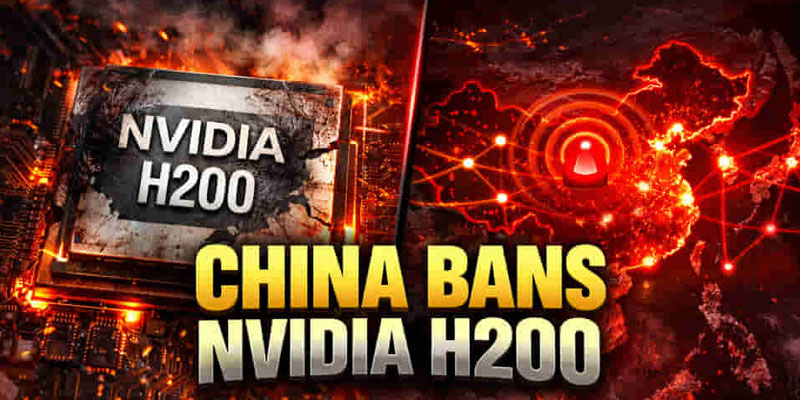
The United States has approved the sale of Nvidia’s advanced H200 artificial intelligence chips to around 10 Chinese companies, marking a significant development in the ongoing technology rivalry between Washington and Beijing. Yet, despite the approvals, no deliveries have taken place so far, leaving the arrangement suspended between regulatory clearance and political uncertainty. The development comes as Nvidia CEO Jensen Huang seeks a breakthrough in US–China technology negotiations amid tightening export controls and rising geopolitical competition over AI dominance.
Approved Buyers and Scope of the Deal
The approved Chinese buyers reportedly include major technology and cloud-computing firms such as Alibaba, Tencent, ByteDance and JD.com. Hardware and supply-chain firms including Lenovo and Foxconn have also received approval to participate in the transaction process.
Under the licensing terms set by the US Commerce Department, each approved buyer can purchase up to 75,000 H200 chips. The chips may be acquired directly from Nvidia or through authorised distributors. Lenovo has confirmed that it has received approval to handle sales, though actual shipments remain pending.
Why the H200 Chip Matters
The H200 is Nvidia’s second-most powerful AI chip and is specifically designed for training advanced AI models and performing sophisticated inference tasks. Its processing capability makes it highly valuable for cloud computing, generative AI systems and large-scale data centres.
However, Washington has attached strict conditions to the sales. Regulations introduced in January 2026 require third-party testing of the chips before shipment to verify their AI functionality. Chinese buyers must also provide proof of adequate security safeguards, and the chips are explicitly barred from military or defence-related applications.
The restrictions reflect America’s dual objective: permitting limited commercial access to advanced AI technology while preventing its use in strategic or security-sensitive sectors.
Political and Commercial Roadblocks
Despite receiving licences, Chinese firms have not rushed to finalise purchases. Reports suggest that Beijing has informally encouraged domestic companies to prioritise Chinese semiconductor firms instead of relying heavily on American hardware.
This caution is tied to broader concerns over technological self-reliance and fears that future US restrictions could abruptly disrupt supply chains. As a result, many Chinese firms appear reluctant to make large commitments without clearer signals from Beijing.
The timing is also politically sensitive. The issue coincides with ongoing negotiations linked to a possible summit between former US President Donald Trump and Chinese President Xi Jinping, where technology exports and AI cooperation are expected to feature prominently.
Strategic Stakes for Nvidia and Global AI Competition
For Nvidia, the situation highlights a growing contradiction in the global AI market. While the US government has technically opened the door for sales, political hesitation in China continues to delay deliveries and revenue generation from one of Nvidia’s most profitable product lines.
For Chinese firms, access to H200 chips could significantly strengthen AI infrastructure and competitiveness. Yet uncertainty surrounding regulations, geopolitical tensions and domestic policy priorities has created a cautious investment environment.
A Delicate Balance Between Commerce and Control
The H200 approvals represent more than a business transaction; they illustrate the fragile balance between economic cooperation and strategic rivalry in the AI era. The regulatory hurdle may have been cleared, but political trust and commercial confidence remain unresolved. Whether shipments eventually move forward will depend not only on licensing conditions, but also on the broader trajectory of US–China relations and the future shape of the global AI supply chain.
(With agency inputs)