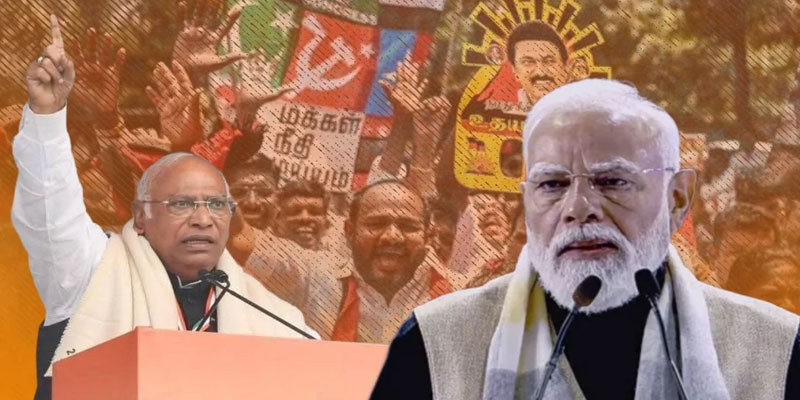
Mallikarjun Kharge triggered a major political controversy on April 21, 2026, after referring to Narendra Modi as a “terrorist” while criticizing the AIADMK-BJP alliance in Chennai. The remark, made in the heat of campaigning ahead of the Tamil Nadu elections, has drawn sharp reactions across the political spectrum, intensifying an already charged environment.
Kharge questioned how a party rooted in Dravidian ideology could align with what he described as an “unequal” BJP, accusing the ruling party at the Centre of weakening democratic institutions. The comments quickly escalated into a broader political and constitutional debate.
Kharge’s Broadside: Alliance Politics and Ideological Clash
At the core of Kharge’s criticism was the renewed alliance between AIADMK and the Bharatiya Janata Party (BJP). He argued that such a partnership contradicts the legacy of Dravidian stalwarts like C.N. Annadurai, who championed social justice and regional autonomy.
Kharge also linked his criticism to what he alleged was a violation of the Model Code of Conduct (MCC) by the Prime Minister. He pointed to Modi’s April 18 address to the nation following the defeat of a key constitutional amendment bill, claiming the speech was politically motivated and indicative of institutional bias.
Privilege Notice: Congress Escalates the Battle
The controversy deepened as KC Venugopal filed a privilege notice against Modi in the Lok Sabha. The notice alleges that the Prime Minister’s address cast “aspersions” on Members of Parliament by criticizing the opposition’s role in blocking the legislation.
Senior Congress leader Jairam Ramesh termed the speech a “blatant abuse” of constitutional authority, demanding that the remarks be expunged from official records. The BJP, however, dismissed the move as a political stunt, accusing the Congress of attempting to deflect attention from its legislative defeat.
The Legislative Trigger: 131st Amendment Fallout
The flashpoint for this confrontation was the failure of the proposed 131st Constitutional Amendment Bill. The bill aimed to operationalize women’s reservation in legislatures through delimitation based on the 2011 Census. Despite securing 298 votes, it fell short of the required special majority of 352.
The government blamed opposition parties for obstructing a key reform for women’s empowerment, while the opposition argued that the bill unnecessarily delayed implementation by linking it to delimitation.
Escalation or Strategy?
The episode reflects a broader trend of escalating rhetoric in Indian politics. Kharge’s remark, while defended by some within the opposition as metaphorical, has provided the BJP with ammunition to portray the Congress as engaging in divisive and disrespectful discourse.
At the same time, the privilege notice signals Congress’s attempt to shift the narrative toward institutional integrity and parliamentary norms. However, such motions rarely succeed without the Speaker’s approval, making it more symbolic than consequential.
A Polarized Political Landscape
This controversy underscores the deepening polarization in Indian politics as elections approach. While sharp rhetoric may energize party bases, it also risks alienating moderate voters and overshadowing substantive policy debates. The clash between Congress and the BJP—spanning personal remarks, parliamentary procedures, and ideological battles—highlights the challenges of maintaining civility and focus in a competitive democratic system. Ultimately, how these narratives shape voter perception will be crucial in determining the political trajectory in the months ahead.
(With agency inputs)