President Murmu’s Historic Rourkela Visit Signals Development Push and Tribal Pride
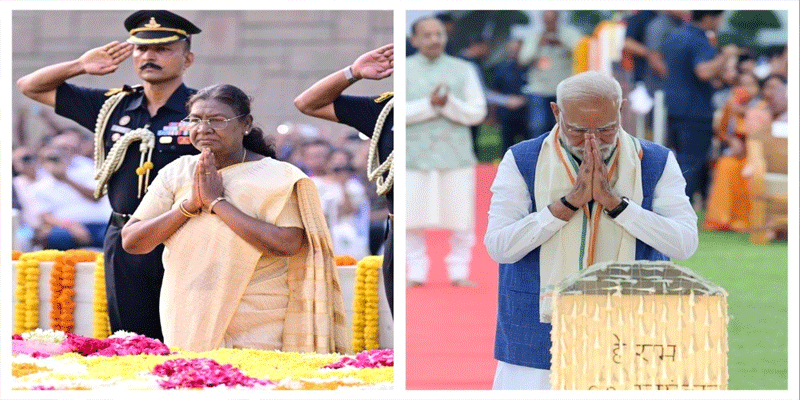
Droupadi Murmu arrived in Odisha on April 21, 2026, marking her first-ever visit to Rourkela—a moment of both symbolic and developmental significance. The President inaugurated projects worth ₹158 crore in the steel city, located in Sundargarh district, amid vibrant tribal celebrations and a large public turnout. Her visit not only highlighted infrastructure expansion but also underscored the region's cultural identity, particularly its strong tribal heritage.
A Grand Public Reception Rooted in Culture
Murmu addressed a massive gathering at Sector-13 near Rourkela Airport, where more than 10,000 school students participated in a cultural showcase. Performances included Odissi, Sambalpuri, Santali, and Karma dances, reflecting the diversity of Odisha’s traditions. Tribal communities such as the Munda, Khadia, Oram, and Bhuian added to the spectacle with traditional displays.
The scale of preparation was significant, with nearly 2,500 to 3,000 participants rehearsing in advance. The venue, designed to accommodate up to 20,000 people, included practical arrangements like water kiosks and cooling systems to manage the summer heat. Self-help group exhibitions also highlighted grassroots entrepreneurship, adding an economic dimension to the cultural event.
Rourkela One Project: Smart Governance Meets Heritage
A key highlight of the visit was the inauguration of the “Rourkela One” project, valued at ₹88 crore. Located near Hockey Square in Civil Township, the initiative integrates modern governance with cultural preservation.
At its core is an Integrated Command and Control Centre (ICCC), designed to enhance urban management through real-time monitoring of traffic, public safety, and disaster response. Alongside this, a state-of-the-art Tribal Museum has been established and handed over to the ST&SC Department. The museum showcases Odisha’s rich tribal heritage, artifacts, and traditions, while also featuring a Hockey Hall of Fame—linking the region’s cultural and sporting legacy.
An auditorium within the complex is expected to serve as a hub for community engagement and cultural events.
Expanding Urban and Educational Infrastructure
In addition to Rourkela One, the President virtually inaugurated two more projects aimed at improving quality of life and educational outreach. These include a ₹42.44 crore recreational park at Koel Nagar and a ₹27 crore Science Park and Planetarium at Chhend Colony.
These facilities are expected to promote leisure, tourism, and STEM education in a city already known for its industrial base. Together, they reflect a broader push to balance economic growth with social and intellectual development.
Symbolism and Strategic Importance
As India’s first tribal President, Murmu’s visit carries deep symbolic weight, particularly in a region where over 30% of the population belongs to Adivasi communities. Her presence reinforces national efforts toward tribal empowerment and cultural preservation.
The visit also highlights coordination between central and state governments, aligning with broader development goals and positioning Rourkela as a model for integrating industrial growth with inclusive progress.
A Convergence of Identity and Development
President Murmu’s visit to Rourkela represents more than a ceremonial milestone—it reflects a strategic convergence of infrastructure development, cultural recognition, and inclusive governance. By investing in smart city systems, educational spaces, and tribal heritage, the initiatives launched during her visit aim to redefine Rourkela’s future. If sustained, this approach could transform the city into a benchmark for balancing modernization with cultural identity in India’s evolving growth story.
(With agency inputs)