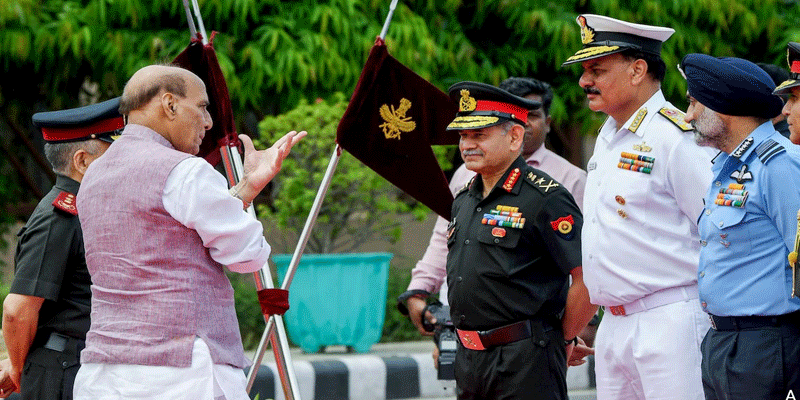
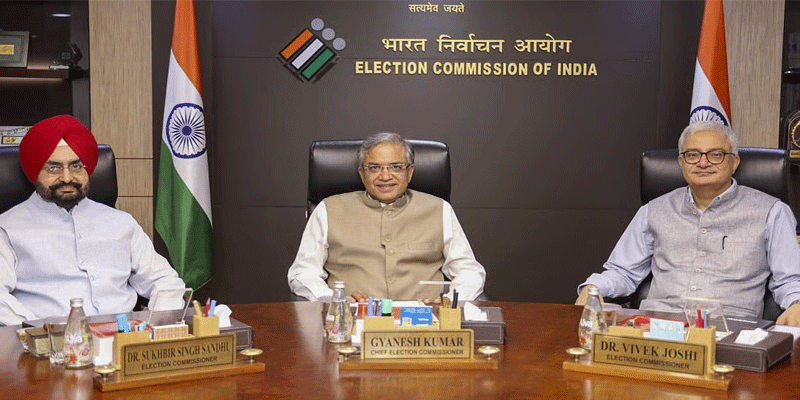
A fierce political confrontation has erupted in West Bengal as the All India Trinamool Congress (TMC) strongly criticizes the unprecedented deployment of central security forces for the 2026 assembly elections. The Election Commission of India (ECI) has stationed a record 2.4 lakh Central Armed Police Forces (CAPF) personnel—spread across 2,407 companies—triggering accusations of a “military-style takeover.” A high-level coordination meeting in Kolkata involving chiefs from forces such as the CRPF, BSF, CISF, ITBP, and SSB has further intensified the political rhetoric.
Massive Deployment: Security at an Unprecedented Scale
The scale of deployment in West Bengal is the largest ever for a single state election. In the initial phases, the ratio translates to roughly one security personnel for every 140 voters. This surpasses even deployments seen in conflict-prone regions like Manipur.
The operation includes advanced logistical support such as bulletproof vehicles sourced from Jammu and Kashmir, and around 500 companies are expected to remain even after polling to ensure secure counting. Sensitive districts like Murshidabad are under particular focus, with a majority of polling booths categorized as vulnerable.
TMC’s Outrage: Allegations of Intimidation
The TMC has mounted a sharp attack on the move, arguing that such a heavy presence of armed personnel could intimidate voters and distort the democratic process. Party leaders have described the deployment as having a “socio-psychological impact,” potentially discouraging participation, especially among rural and minority communities.
Chief Minister Mamata Banerjee and her allies have also raised concerns about alleged bias, pointing to the central government’s control over these forces. They argue that the deployment reflects a broader political strategy by the ruling party at the Centre to influence elections in opposition-ruled states.
ECI’s Justification: Data-Driven Security Measures
The Election Commission, however, has defended its decision, citing West Bengal’s history of electoral violence. Data indicates that the state accounted for nearly 35% of all poll-related deaths in India between 2019 and 2025. The 2021 assembly elections alone witnessed around 300 violent incidents and 58 deaths, making them among the bloodiest in recent memory.
Subsequent bypolls and national elections have also recorded significant violence, with 144 sensitive constituencies identified during the 2024 Lok Sabha elections. The ECI maintains that such a security presence is essential to ensure free and fair voting, particularly in areas with a history of booth capture and intimidation.
Necessary Safeguard or Excessive Force?
The debate over the deployment reflects a deeper tension between security and perception. On one hand, the scale aligns with the high-risk profile of the state, where a majority of booths are considered sensitive. Central forces are often viewed as neutral compared to state police, which opposition parties frequently accuse of bias.
On the other hand, the sheer magnitude of the deployment raises valid concerns about optics. In a politically polarized environment, such measures can be interpreted as coercive, potentially influencing voter behavior.
Balancing Security and Democratic Confidence
The massive CAPF deployment in West Bengal underscores the complexities of conducting elections in politically volatile regions. While the Election Commission’s data-driven approach aims to curb violence and ensure neutrality, the concerns raised by TMC highlight the importance of maintaining public trust in the electoral process. Ultimately, the success of this strategy will depend on whether it delivers peaceful, credible elections without alienating voters. Striking this balance remains crucial for safeguarding both security and democratic integrity.
(With agency inputs)