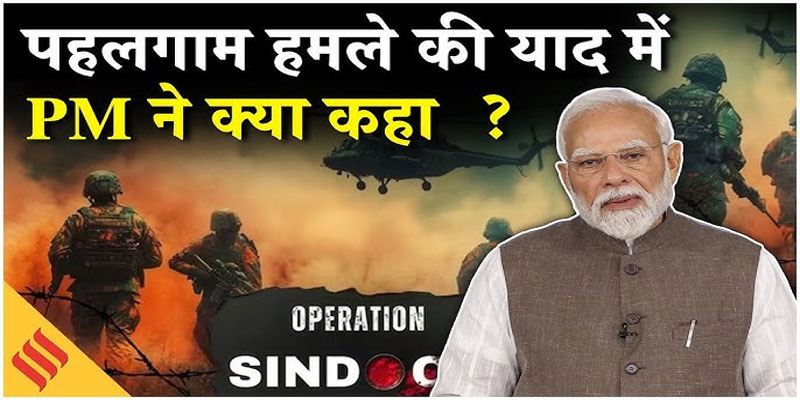
On the first anniversary of the Pahalgam terror attack, Narendra Modi paid homage to the victims, stating that the innocent lives lost would always be remembered. He reiterated that India would never bow to terror and that the pain of the families affected remains etched in the nation’s collective conscience. His message underscored both remembrance and resolve—honouring those lost while reaffirming India’s commitment to confronting terrorism decisively.
The Day the Valley Bled
On 22 April 2025, the serene meadows of Baisaran Valley near Pahalgam transformed into a site of horror. Often described as “mini-Switzerland” for its picturesque beauty, the valley became the stage for one of the deadliest civilian attacks in recent years.
In the mid-afternoon, four to six militants, dressed in combat-style gear, emerged from the dense pine forests surrounding the meadow. Eyewitness accounts revealed a chilling strategy: while some attackers entered through the main access point, another blocked the exit, trapping unsuspecting tourists within the valley. What followed was a calculated and brutal assault.
Gunfire erupted without warning, targeting visitors who had gathered to enjoy clear skies after days of rain. Families, newlyweds, and tourists from across India—including West Bengal, Karnataka, and Maharashtra—were caught in the crossfire. In total, 26 civilians lost their lives. Investigations later suggested that some victims were profiled by religion, pointing to a deliberate sectarian motive behind the massacre.
The scale and nature of the attack shocked the nation. Beyond the tragic loss of life, it dealt a severe psychological blow to Kashmir’s tourism-dependent economy. For many, the Pahalgam killings evoked memories of past violence, yet stood apart due to the sheer magnitude of civilian casualties in a single incident.
Operation Sindoor: India’s Strategic Response
In the early hours of 7 May 2025, India responded with Operation Sindoor, a coordinated tri-service military action aimed at dismantling terror infrastructure. Within two weeks of the attack, the Indian Army, Air Force, and Navy launched precision strikes on nine identified terror launchpads and support facilities across Pakistan and Pakistan-occupied Kashmir.
Key targets included strongholds associated with groups such as Jaish-e-Mohammed and Lashkar-e-Taiba, notably in Bahawalpur and Muridke. Officials emphasized that the strikes were carefully calibrated—focused solely on terrorist infrastructure, avoiding civilian areas and Pakistani military installations.
This measured approach aimed to send a strong message without triggering full-scale conflict. In response, Pakistan increased troop deployments along the border, leading to heightened tensions. However, both nations refrained from escalating into a broader war.
Strategically, Operation Sindoor reinforced India’s doctrine established after earlier responses like the Uri attack and Balakot airstrike—that large-scale terror attacks would invite swift, cross-border retaliation. Domestically, it reassured citizens of the government’s resolve to act decisively while maintaining strategic restraint.
One Year On: Memory, Deterrence, and National Resolve
A year later, the memory of Pahalgam remains vivid. The anniversary serves not only as a tribute to those who lost their lives but also as a reaffirmation of India’s stance against terrorism. It highlights a dual narrative—mourning and strength—where grief is transformed into a collective determination to prevent such tragedies.
Prime Minister Modi’s message reflects this enduring resolve: that while the scars of Pahalgam will never fully fade, they strengthen India’s commitment to unity and security. The legacy of the victims lies not only in remembrance but in shaping a future where such acts are met with unwavering resistance.
In the broader context, the Pahalgam attack and Operation Sindoor together signal a clear message—India will neither forget nor forgive acts of terror, and will continue to respond with calibrated strength while striving to safeguard peace.
(With agency inputs)