Police Rope in Courier Firms to Curb Narcotics Flow
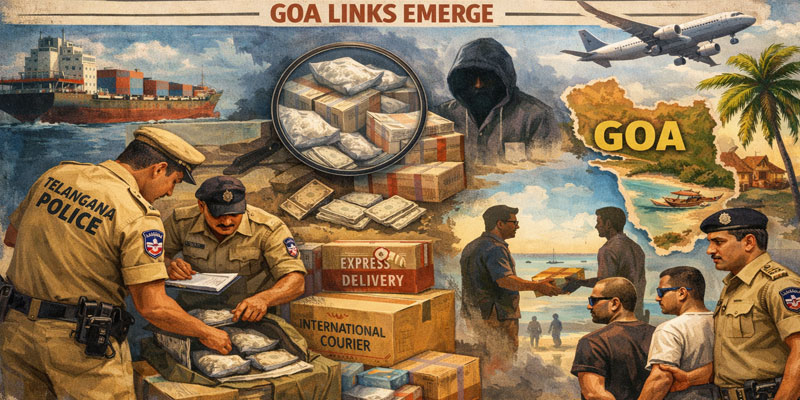
Goa Police have sounded the alarm over a new trafficking trend, warning that narcotics are increasingly entering the state through courier and postal networks rather than only through traditional road and sea routes. In response, senior police officials recently held an awareness and coordination meeting with 75–80 representatives from courier companies and postal service providers in Panaji, urging them to become active partners in detecting suspicious consignments.
The move follows the discovery earlier this year of hashish concealed beneath a steam iron inside a posted parcel—an incident that exposed how traffickers are exploiting legitimate logistics infrastructure while keeping delivery personnel unaware of the illegal contents.
A New Challenge in Goa’s Drug War
Goa has long battled narcotics trafficking linked to tourism, nightlife and coastal routes. However, investigators now believe criminal networks are increasingly relying on ordinary parcels to move drugs anonymously.
Police say cannabis and hashish are particularly being transported through small courier packages and postal deliveries, allowing traffickers to avoid direct physical contact with buyers while reducing the risk of interception during transportation.
The changing modus operandi has made enforcement more complex, as logistics companies often possess delivery records without knowing the true identity or intentions of those sending the packages.
How Traffickers Exploit Delivery Networks
Officials have identified several tactics commonly used by drug syndicates.
· Parcels are booked using false identities or incomplete sender and receiver details.
· Package declarations often do not match their actual contents or value.
· Drugs are hidden inside everyday household items to avoid suspicion.
· Buyers increasingly receive drugs through “dead drops”, where they are sent collection coordinates instead of meeting dealers directly.
This system offers traffickers greater anonymity while turning unsuspecting delivery workers into unwitting participants in the supply chain.
Police Build Partnership with Courier Companies
Recognising that enforcement alone cannot solve the problem, Goa Police are seeking closer collaboration with logistics operators.
During the Panaji meeting, the Anti-Narcotics Cell educated participants about concealment techniques, legal provisions under the Narcotic Drugs and Psychotropic Substances Act, 1985, and indicators of suspicious shipments.
Authorities have also created a WhatsApp coordination group linking police officers, courier firms and delivery partners to facilitate quick reporting of doubtful consignments, particularly those found near schools, clubs and vulnerable coastal areas.
The initiative forms part of Goa’s three-year action plan under the Nasha Mukt Bharat Abhiyan, while police have also promoted the MANAS National Narcotics Helpline (1933) to encourage public reporting.
The Bigger Drug Trafficking Picture
The postal route represents only one dimension of Goa’s broader narcotics challenge. Police frequently seize ganja, charas, LSD, MDMA, cocaine and methamphetamine across the state.
According to investigators, cannabis often arrives from Jharkhand and Odisha, charas from Himachal Pradesh and Nepal, while synthetic drugs enter through multiple interstate routes.
Enforcement data reflects sustained pressure. Police registered 140 narcotics cases with 166 arrests in 2023, followed by 192 arrests in 2024 and 213 arrests in 2025. By August 12, 2026, authorities had already registered 122 cases and arrested 135 people.
Turning Delivery Networks into the First Line of Defence
Goa’s partnership with courier and postal providers marks a pragmatic shift in anti-drug enforcement. Yet its long-term success will depend on effective implementation through stronger Know Your Customer checks, risk-based parcel screening, secure data-sharing and protection for employees who report suspicious shipments. As traffickers continue adapting their methods, safeguarding legitimate delivery networks could become one of the state’s most important defences against the evolving narcotics trade.
(With agency inputs)