Inheritance Disagreement Raises Questions Over Family Ownership and Corporate Governance
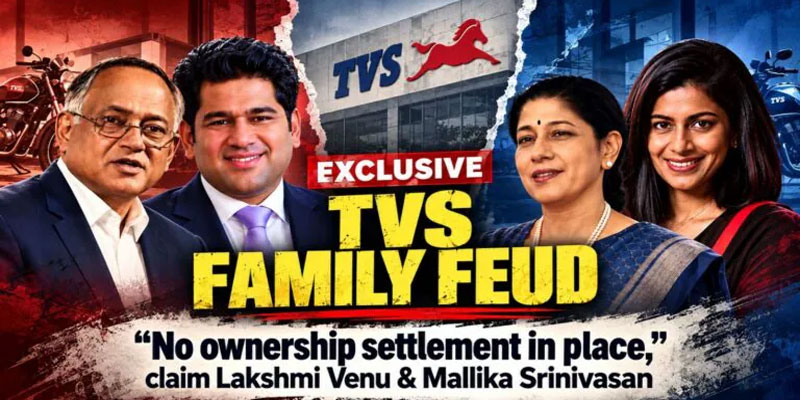
Lakshmi Venu, daughter of TVS Motor Company Chairman Emeritus Venu Srinivasan, has formally sought a partition of family assets, asserting her legal rights under the Hindu Succession Act. The development has brought a closely held family disagreement into the public domain, with her mother, Mallika Srinivasan, backing her demand for a fair and transparent division of economic interests. The dispute is significant not only for the prominent TVS family but also for its potential implications for ownership structures and corporate governance within the group's listed companies.
The 2020 TVS Family Settlement
The disagreement follows a broader family settlement reached in 2020 and subsequently implemented to divide assets across the wider TVS family. However, Lakshmi and Mallika maintain that this arrangement did not adequately resolve the ownership and distribution of assets within the Venu Srinivasan family branch. In a joint statement, they indicated that no comparable process involving transparent valuation, consultations and mutual consent had taken place to determine the economic interests of family members. They also maintained that no final agreement dividing those interests had been concluded.
Lakshmi Venu's Legal Claim: Ownership Beyond Management
Lakshmi's formal notice invokes her rights under the Hindu Succession Act, seeking recognition of her rightful economic share in the family assets.
An important distinction in the dispute is between management responsibilities and ownership entitlements. Mallika and Lakshmi have clarified that their concerns are not about executive positions or management compensation, which they acknowledge have been appropriately addressed.
Their central demand concerns the fair determination and distribution of economic ownership.
Venu Srinivasan's Position: Assets and Equitable Distribution
Venu Srinivasan, meanwhile, maintains that the assets under discussion are his personal properties, which he is entitled to manage and distribute as he considers appropriate. He has also argued that the allocation between his two children was fair and equitable, taking December 10, 2020, the date of the broader TVS family settlement, as the relevant reference point. This difference in interpretation lies at the heart of the disagreement.
Corporate Governance Concerns and Shareholder Implications
The dispute has attracted attention from governance advisory firm InGovern, which has flagged potential governance risks for listed entities TVS Holdings and TVS Motor Company. Although ownership transfers and management changes have reportedly followed formal corporate procedures, InGovern has questioned the absence of publicly disclosed details of a March 2024 memorandum of understanding.
It has also warned that reopening family settlements after ownership transfers could create uncertainty and potentially affect minority shareholders.
The Road Ahead: Family Settlement or Legal Battle?
Ultimately, the TVS dispute highlights the complexities of inheritance, personal ownership and succession planning in large business families. An amicable settlement through transparent discussions would protect both family relationships and corporate stability. However, failure to reach consensus could lead to formal legal proceedings. Beyond the immediate question of asset division, the outcome will be closely watched for its implications for shareholder confidence, governance standards and succession management across India's major family-controlled business groups.
(With agency inputs)