India is set to retain its position as the world’s fastest-growing major economy, with the International Monetary Fund (IMF) projecting the economy to expand by 7 per cent in calendar year 2026. The latest assessment reinforces confidence in India’s economic resilience despite mounting global uncertainties, including trade tensions, geopolitical conflicts and volatile energy prices. While the IMF expects India to continue outperforming other major economies, it also cautions that sustaining this momentum will become increasingly challenging as the global economic environment grows more uncertain.
India’s Strong Growth Story
Over the past decade, India has consistently emerged as one of the world's fastest-growing large economies, driven by robust domestic consumption, expanding services, rising public investment and ongoing structural reforms. Unlike many export-oriented economies that remain highly vulnerable to global demand fluctuations, India’s growth has largely been powered by its vast domestic market.
Strong household spending, a rapidly expanding digital economy, infrastructure development and government-led capital expenditure have helped sustain economic activity even during periods of international volatility. This domestic demand has enabled India to weather global disruptions more effectively than many advanced and emerging economies.
At the same time, continued improvements in financial stability, manufacturing initiatives and investment in physical and digital infrastructure have strengthened India's long-term growth potential.
What the IMF Report Highlights
The IMF’s latest outlook projects India to remain the fastest-growing major economy in 2026, underscoring the country's strong macroeconomic fundamentals. Earlier this year, the Fund had raised India's fiscal year 2026 growth forecast to 7.3 per cent, reflecting optimism over resilient domestic demand. While subsequent projections indicate a slightly moderated trajectory over the coming years, India is still expected to outperform all other major economies.
The report highlights that strong momentum in private consumption and services activity continues to support economic expansion. This is particularly significant because consumption-led growth provides India with an important cushion against weakening global trade and slowing external demand.
However, the IMF also indicates that the exceptionally rapid pace witnessed in recent years may gradually moderate as global economic conditions become more complex.
Challenges from the Global Economy
Despite its strong domestic fundamentals, India remains connected to the global economy and cannot remain entirely insulated from external shocks. The IMF points to slower global growth, rising geopolitical tensions, protectionist trade measures and elevated energy prices as major risks to future economic performance.
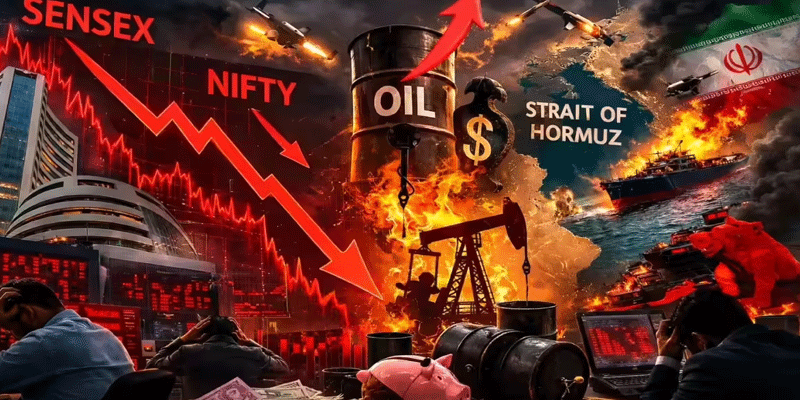
Higher crude oil prices remain a particular concern for India, given its dependence on energy imports. Rising energy costs can fuel inflation, increase production expenses, affect corporate profitability and widen the current account deficit. Such pressures may complicate the policy balance between sustaining growth and controlling inflation.
Policy Priorities Going Forward
The IMF’s assessment suggests that India’s next phase of growth should focus on improving resilience rather than merely maintaining high growth rates. Strengthening manufacturing, enhancing export competitiveness, expanding clean energy capacity and reducing external vulnerabilities will be essential.
Equally important will be sustaining domestic consumption while encouraging greater private investment and productivity improvements. A more balanced growth model can help India withstand future global disruptions and preserve long-term economic momentum.
Sustaining the Growth Momentum
The IMF’s latest projections reaffirm India’s position as the world’s leading growth engine among major economies, but they also underline that future success cannot be taken for granted. As global uncertainties intensify, India's economic strength will increasingly depend on its ability to convert strong domestic demand into more diversified, resilient and investment-driven growth. By continuing reforms, strengthening macroeconomic stability and enhancing competitiveness, India can not only sustain its growth leadership but also reinforce its role as a key pillar of the global economy.
(With agency inputs)