Russian Foreign Minister Sergey Lavrov has suggested that India could emerge as a long-term mediator between Iran and the United States amid escalating tensions in West Asia, highlighting New Delhi’s diplomatic credibility and balanced regional relationships. Lavrov’s remarks came during Prime Minister Narendra Modi’s visit to the United Arab Emirates, where energy security and regional stability dominated discussions against the backdrop of rising geopolitical uncertainty.
The comments reflect growing international recognition of India’s expanding strategic influence in West Asia, especially at a time when tensions surrounding Iran, the Strait of Hormuz and broader regional security continue to affect global energy markets.
Pakistan’s Immediate Role in US-Iran Dialogue
Lavrov acknowledged that Pakistan is currently playing a more immediate role in facilitating communication between the United States and Iran. According to him, Islamabad is helping support discussions linked to urgent concerns such as maintaining the ceasefire environment and ensuring the reopening and stability of the Strait of Hormuz.
Pakistan’s geographical proximity to Iran and its established diplomatic channels with Tehran make it well-positioned for short-term de-escalation efforts. The focus of these discussions is reportedly practical and crisis-oriented, aimed at preventing further instability in the Gulf region.
The Strait of Hormuz remains one of the world’s most critical maritime trade routes, carrying a substantial portion of global oil and gas exports. Any disruption there has immediate economic consequences worldwide.
Why Lavrov Believes India Can Play a Larger Role
While Pakistan may assist in immediate diplomacy, Lavrov argued that India possesses the strategic depth and international standing required for a broader and longer-term mediation role. He noted that India’s diplomatic experience and credibility with multiple stakeholders place it in a unique position to encourage sustained dialogue and regional stability.
India maintains strong ties simultaneously with Iran, Israel, Saudi Arabia, the UAE and the United States. This rare diplomatic balance allows New Delhi to engage with competing regional actors without being viewed as overtly aligned with any one bloc.
Lavrov suggested that India could eventually help establish broader peace frameworks involving Iran and Arab states if regional powers seek a neutral and trusted facilitator.
Strategic Stakes for India
India has direct economic and strategic reasons to support peace in West Asia. As one of the world’s largest energy importers, India depends heavily on stable oil and gas supplies from the Gulf region. Any prolonged disruption in Hormuz could significantly affect domestic inflation, growth and fiscal stability.
India also has a large overseas workforce across Gulf countries, making regional peace essential for both economic and humanitarian reasons. Stable ties with Gulf nations additionally support trade, investment and long-term connectivity initiatives.
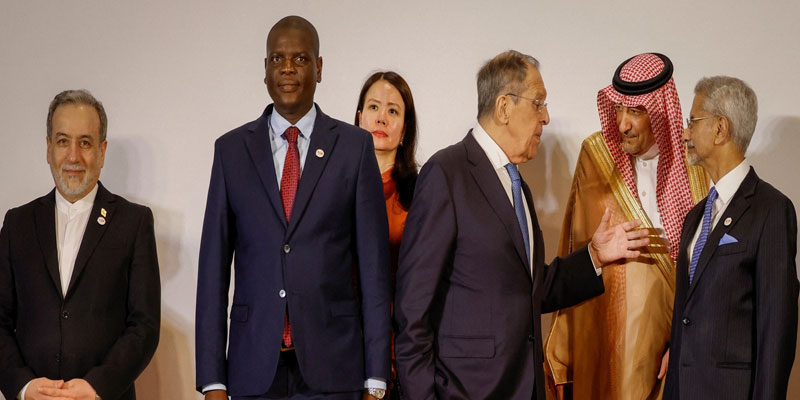
India’s current chairmanship of BRICS further strengthens its diplomatic influence. Recent meetings in New Delhi involving Iranian Foreign Minister Abbas Araghchi and Lavrov focused on energy security, maritime stability and Global South cooperation.
Challenges to India’s Balancing Strategy
Despite its advantages, India’s mediation potential also comes with risks. Its strategy of maintaining strategic autonomy requires careful balancing between rival powers and regional blocs. Any perception of leaning too closely toward Washington or any Gulf power could weaken its credibility with Tehran.
The evolving composition of BRICS, which now includes both Iran and several Arab partners, may also complicate consensus-building within the grouping.
Quiet Diplomacy May Define India’s Emerging Role
Lavrov’s remarks indicate that India is increasingly being viewed as a stabilising diplomatic force capable of contributing to long-term regional peace. However, India’s role is likely to remain cautious and facilitative rather than overtly interventionist.
Rather than acting as a high-profile peace broker, New Delhi may focus on behind-the-scenes diplomacy, leveraging its strategic partnerships and economic influence to encourage dialogue, protect energy security and preserve stability in one of the world’s most sensitive regions.
(With agency inputs)