Delhi’s traders have presented Rahul Gandhi with an awkward festive-season challenge: prove that his political rally will bring customers into their markets, or consider postponing it until after Diwali. The Chamber of Trade and Industry (CTI) has proposed a 20-minute meeting with 20 traders representing 20 markets, turning the Congress leader’s planned show of political strength into a test of commercial common sense.
Why Traders Are Challenging the Rally
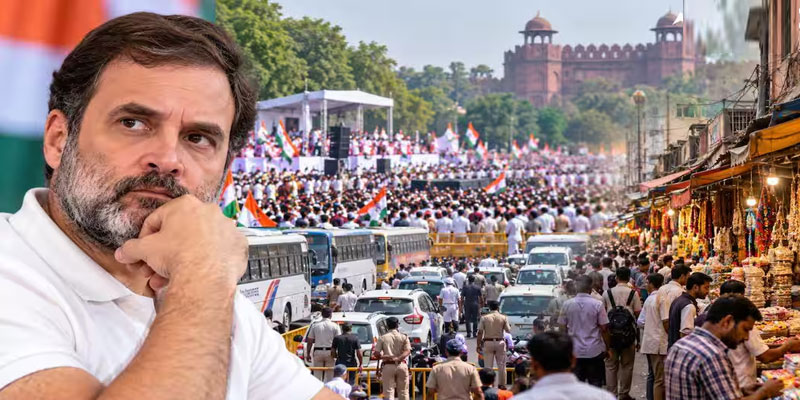
The Congress-led INDIA bloc has scheduled a rally at Ramlila Maidan on November 1 to protest alleged “vote chori” and demand the resignation of Chief Election Commissioner Gyanesh Kumar over alleged irregularities in the Special Intensive Revision (SIR) of electoral rolls.
However, the proposed gathering coincides with one of Delhi’s busiest shopping periods. CTI chairman Brijesh Goyal has reportedly written to Gandhi, warning that security restrictions, traffic diversions and crowd movement could disrupt business across major wholesale and retail markets.
The traders’ concern is straightforward: political mobilisation may be temporary, but the financial consequences of losing crucial Diwali sales could last much longer.
₹10,000 Crore at Stake, Claims CTI
· Chandni Chowk and Sadar Bazar
· Karol Bagh and Khari Baoli
· Bhagirath Palace and Chawri Bazar
· Kashmere Gate, Daryaganj and Jama Masjid–Meena Bazaar
CTI has warned that disruption could result in losses of approximately ₹10,000 crore. This is the organisation’s estimate, not a verified assessment of actual losses. Its argument centres on restricted customer access, interrupted deliveries and difficulties transporting goods during the festive rush.
The “20-20-20” Challenge to Rahul Gandhi
The proposal is simple: 20 markets, 20 traders and 20 minutes. Gandhi is invited to hear their concerns and explain how the rally would increase customer footfall and business.
CTI has offered a conditional bargain:
· If Gandhi convinces traders: They will withdraw their opposition and welcome the rally.
· If traders establish the risks: They want the event postponed until after Diwali, potentially November 10.
The challenge puts the burden on political organisers to demonstrate that their plans will not unfairly inconvenience businesses.
Politics Versus Festive Commerce
Postponement could weaken the INDIA bloc’s planned show of strength, while proceeding without adequate arrangements could invite criticism from traders. CTI has also suggested shifting the event to Burari Ground.
Political Slogans Cannot Replace Business Sense
Rahul Gandhi now faces an unusual test: can a rally opposing alleged electoral irregularities accommodate the concerns of Delhi’s trading community?
A postponement is far from certain, but dismissing traders’ concerns could prove politically counterproductive. The sensible compromise is coordinated traffic management, protected market access and police consultation. A political rally may command headlines, but during Diwali, Delhi’s traders want customers—not barricades.
(With agency inputs)