The global economy is once again feeling the tremors of President Donald Trump’s tariff battles, with India now caught in the line of fire. After months of friction over Russian oil imports, New Delhi is facing fresh pressure from Washington—this time over American corn. The dispute underscores the deepening strains in one of the world’s most consequential economic relationships, where trade has increasingly become a weapon of diplomacy.
US Commerce Secretary Howard Lutnick recently sharpened the rhetoric, warning that India could face restrictions in accessing the lucrative American market if it continued blocking US agricultural exports. Speaking in an interview with Axios, Lutnick complained that while India sells widely to the US, it “won’t buy one bushel of US corn.” His pointed remark— “they put tariffs on everything”—captured the frustration in Washington, where officials view India as overly protectionist.
Lutnick’s comments followed earlier complaints about India’s refusal to reduce barriers to foreign goods, despite benefitting from American openness. “The president says, ‘fair and reciprocal trade,’” he said, insisting that years of imbalance must be corrected through higher tariffs on Indian imports until the playing field is level.
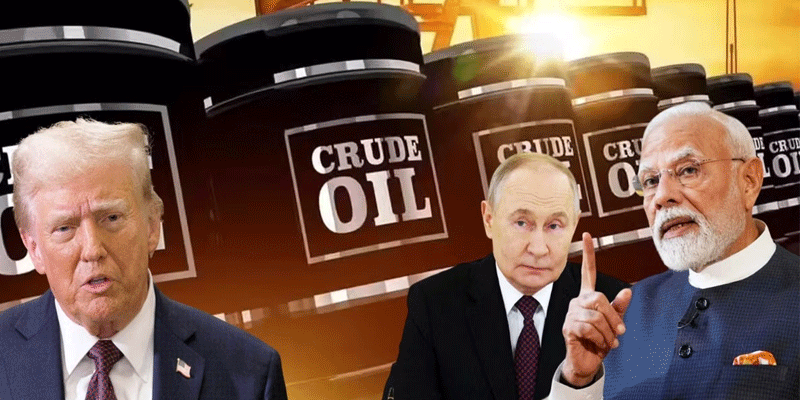
Trump himself has escalated the pressure. After initially hinting that a bilateral trade deal was within reach, he abruptly doubled tariffs on Indian goods, raising duties on several products to as high as 50 percent. Indian officials described the move as “unfair and unreasonable,” especially as Washington simultaneously penalised New Delhi’s purchase of Russian crude oil with steep levies.
The sudden tariff hikes have not only disrupted businesses but also cast doubt on the broader trajectory of US-India relations, which had appeared to strengthen during Trump’s first term. For India, the moves are a double blow: the loss of trade preferences combined with strategic rebukes over energy choices.
India’s Refusal on Corn Imports
Central to the new dispute is India’s rejection of genetically modified (GM) corn, which accounts for nearly all of US corn production. India’s trade negotiators argue that permitting GM imports would compromise national regulations and hurt smallholder farmers who dominate domestic production. As the world’s fifth-largest producer of corn, India maintains that it is largely self-sufficient and seeks to shield its agricultural sector from being swamped by American agribusiness giants.
The cultural and economic stakes are significant. Corn in India is cultivated primarily by small farmers, while in the US it is grown by massive, mechanized corporate farms. Permitting imports, New Delhi argues, would erode rural livelihoods and challenge food security standards. Even limited proposals—such as allowing GM corn for ethanol production—have met stiff resistance.
Why the US is Pushing So Hard
For Washington, corn is more than just an agricultural commodity—it is a political lifeline. American farmers, many of whom form Trump’s electoral base, are reeling from the collapse of Chinese purchases. Once the biggest buyer of US corn and soybeans, China has slashed imports amid its trade war with Washington, forcing American producers into crisis.
Figures tell the story: US corn exports to China dropped from 31 percent of total shipments in 2020–21 to under 6 percent last season. Bankruptcy filings among farmers have climbed, and industry groups warn of severe strain. Against this backdrop, the administration sees India’s massive population and rapidly growing demand as a crucial replacement market.
By 2050, India’s corn consumption is projected to exceed 200 million tonnes, far surpassing domestic production. For American agribusiness, breaking into India now is seen as essential to capturing that long-term demand.
Diplomatic Overtures and Sharp Words
Despite the aggressive stance, Trump has recently signaled willingness to reopen dialogue. He expressed optimism about striking a trade deal with Prime Minister Narendra Modi, emphasizing goodwill and personal rapport. Reports suggest US negotiators will arrive in New Delhi soon, though Lutnick’s corn ultimatum may complicate the atmosphere.
The contradiction is clear: even as Washington threatens penalties, it seeks deeper trade ties with India, reflecting the complex mix of confrontation and cooperation shaping the relationship.
India’s Perspective
From New Delhi’s standpoint, the demands are both unreasonable and intrusive. Officials argue that energy imports from Russia are dictated by national interest and affordability, while blocking GM corn protects food safety and farmers’ livelihoods. India has framed the tariff hikes as unilateral coercion, warning that such measures could erode trust and destabilize ties between two major democracies.
At the same time, India recognises the importance of maintaining strong economic links with the US, particularly as both nations position themselves as strategic partners in countering China’s rise. This balancing act—asserting sovereignty while preserving cooperation—lies at the heart of India’s trade diplomacy.
A Wider Geopolitical Context
The corn quarrel is not happening in isolation. It reflects a broader realignment of global trade in the wake of US-China tensions. As Washington seeks to diversify away from China, allies and partners like India, Brazil, and Vietnam are becoming new battlegrounds for market access. Trump’s approach—mixing tariffs, threats, and personal diplomacy—illustrates how economic tools are being wielded for political ends.
Testing the Partnership
The tariff clash over corn may appear narrow, but it carries wider implications for the future of US-India relations. For Trump, securing markets for American farmers is both an economic and political imperative. For India, resisting external pressure on food sovereignty and trade policy is equally vital.
The challenge is to find common ground without derailing a partnership that has strategic significance well beyond tariffs and commodities. If both sides can transform confrontation into negotiation, the dispute might even strengthen mutual respect. But if ultimatums prevail, the world’s two largest democracies risk stumbling into a trade rivalry that undermines the very cooperation they both claim to value.
(With agency inputs)