A Landmark Claim in Parliament
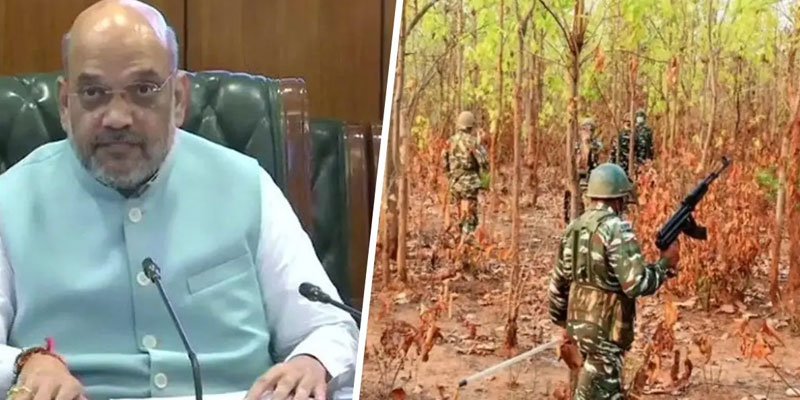
Union Home Minister Amit Shah has declared that Naxalism is “almost completely eradicated” from Chhattisgarh’s Bastar region, marking what he described as a decisive shift in one of India’s longest-running internal security challenges. Speaking in the Lok Sabha, Shah credited the government’s sustained efforts for transforming Bastar from a Maoist stronghold into a region moving toward development, while blaming decades of neglect by the Congress for allowing extremism to take root. His remarks were strongly backed by Prime Minister Narendra Modi.
From Conflict Zone to Development Narrative
Bastar, once synonymous with Left-Wing Extremism, is now being projected as a model of change. Shah emphasized that the government’s March 31 deadline to make India Naxal-free has largely been achieved in the region. He pointed to tangible grassroots initiatives—such as building schools and ensuring ration shops in every village—as indicators of a shift from insurgency to inclusion.
At the same time, Shah mounted a sharp political attack on the Congress, questioning why tribal communities remained underdeveloped despite decades of its rule. According to him, the current government has replaced what he termed a “shadow of Red Terror” with governance and growth.
Strategy: Security Meets Development
The government’s approach to tackling Naxalism has been anchored in a dual strategy—firm security action combined with expanded development outreach. Shah highlighted a significant decline in Naxal-affected districts, from over 120 a decade ago to around three dozen today. Incidents of violence and the number of affected police stations have also dropped sharply.
On the security front, coordinated operations between central and state forces have intensified pressure on insurgents. Data shared by Shah indicates that thousands of Naxalites have either surrendered or been arrested, while several hundred were killed in encounters after refusing to lay down arms. This sustained crackdown has disrupted the operational capabilities of Maoist groups.
Parallel to this, the government has pushed infrastructure deep into previously inaccessible areas. Roads, mobile connectivity, banking services, and welfare schemes have been expanded across Bastar. This combination—often framed as development alongside trust-building—aims to address the root causes of alienation while maintaining a zero-tolerance stance on violence.
Political Messaging and Ground Realities
Prime Minister Modi praised Shah’s address as a comprehensive account of the government’s efforts, reinforcing the narrative of a decisive breakthrough. Politically, the claim of near-eradication serves multiple purposes: it showcases the government’s effectiveness, contrasts it with past administrations, and positions Bastar as a success story of governance ahead of future elections.
However, the broader picture remains nuanced. While Bastar has seen a significant reduction in Maoist activity, remnants of Left-Wing Extremism persist in parts of Chhattisgarh and neighboring states like Jharkhand, Odisha, and Maharashtra. Experts caution that long-term success will depend not just on security gains but also on safeguarding tribal rights, ensuring equitable development, and maintaining administrative presence in remote areas.
Progress with Caution
The transformation of Bastar represents a significant milestone in India’s fight against Naxalism. The combination of security operations and development initiatives has undeniably weakened insurgent networks and improved state reach. Yet, declaring complete victory may be premature.
Sustaining peace will require continued investment in infrastructure, education, and livelihoods, along with sensitivity to local concerns. If these gains are consolidated, Bastar could indeed stand as a lasting example of how complex internal conflicts can be resolved. If not, the risk of resurgence, however limited, cannot be entirely ruled out.
(With agency inputs)