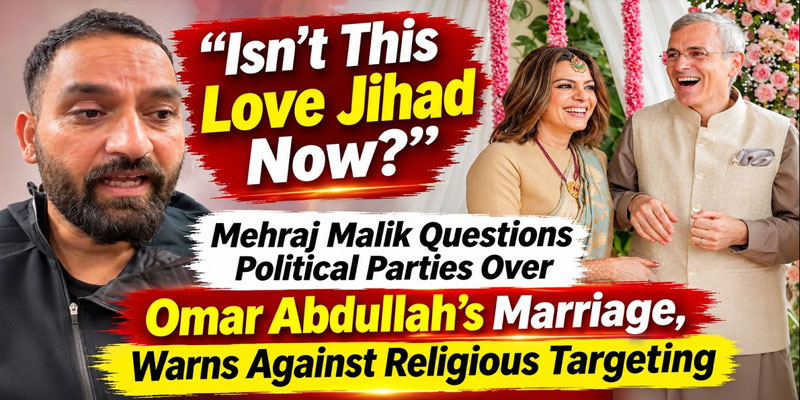
Jammu and Kashmir Chief Minister Omar Abdullah has announced his marriage to senior journalist Nidhi Razdan, triggering a controversy over religious beliefs, interfaith relationships and the legal validity of marriage in India. The couple announced their wedding through social media on October 31, revealing that the ceremony had taken place a day earlier. While the marriage has attracted congratulatory messages, a cleric's declaration that the union is impermissible under his interpretation of Islamic law has brought the personal occasion into the centre of a wider public debate.
Who Are Omar Abdullah and Nidhi Razdan?
Omar Abdullah, 56, is a senior Jammu and Kashmir National Conference leader and the sitting Chief Minister of Jammu and Kashmir. He is the son of veteran politician Farooq Abdullah and grandson of National Conference founder Sheikh Abdullah. He has been a prominent figure in Jammu and Kashmir politics, serving earlier as Chief Minister from 2009 to 2014.
Nidhi Razdan, 49, is an established Indian journalist and television anchor, best known for her long association with NDTV, where she covered national politics and international affairs. Kashmir-born, she has built a prominent career in broadcast journalism and is also the author of Left, Right and Centre: The Idea of India.
What Happened and Under Which Law Did They Marry?
The couple formalised their marriage on October 30, 2026, and announced it publicly the following day. Omar shared photographs with Razdan, writing, "A new journey began yesterday", while she posted, "It's done bro".
According to reports, the marriage was solemnised under the Special Marriage Act, 1954, which provides a civil legal framework for marriages irrespective of religious differences. The ceremony was attended by close family members from both sides.
The timing also attracted attention because the Supreme Court had dissolved Omar Abdullah's previous marriage to Payal Abdullah by mutual consent on July 31, 2026. The former couple, who married in 1994 and have two sons, had been living separately for several years.
Why Has the Marriage Become Controversial?
The controversy erupted after Maulana Mufti Shahabuddin Razvi Barelvi, president of the All India Muslim Jamaat, declared the marriage najaayaz, meaning impermissible, under his interpretation of Islamic law.
His principal arguments are:
· Religious identity: He maintains that an Islamic nikah requires both partners to be Muslim.
· Conversion requirement: According to his interpretation, Nidhi Razdan would have needed to embrace Islam before the marriage could be recognised as a valid nikah.
· Religious permissibility: He questioned the union on the grounds that the couple reportedly belong to different religious backgrounds.
However, this represents the cleric's particular religious interpretation and should not be confused with a universally binding ruling across Muslim communities.
Fatwa Versus Indian Law: What Is the Difference?
This is the central point of the controversy. A fatwa is a religious opinion or interpretation issued by an Islamic scholar; it is not a judicial order under Indian law.
Since the couple reportedly married under the Special Marriage Act, 1954, their marriage is recognised as a civil union, provided the statutory requirements have been fulfilled. The law does not require either partner to convert to the other's religion.
Therefore, the cleric's objection concerns religious permissibility under his interpretation of Sharia, not the marriage's validity under India's civil legal framework.
Personal Freedom, Religious Authority and Public Debate
The episode has attracted attention partly because Abdullah is a sitting Chief Minister and Razdan is a nationally recognised journalist. Their personal decision has consequently become a subject of public scrutiny, bringing questions of individual choice, religious identity and social acceptance into the political and public domain.
When Personal Choice Meets Religious Boundaries
The controversy ultimately highlights the distinction between religious beliefs and constitutional civil rights. Individuals entering a lawful civil marriage are entitled to exercise their personal choices without religious conversion being imposed as a legal condition. While religious institutions and scholars can express their interpretations, those opinions do not override Indian marriage law. The larger question is whether society can respect personal freedom while allowing space for differing religious beliefs. A marriage's civil validity must be determined by law, not by competing religious opinions.
(With agency inputs)